
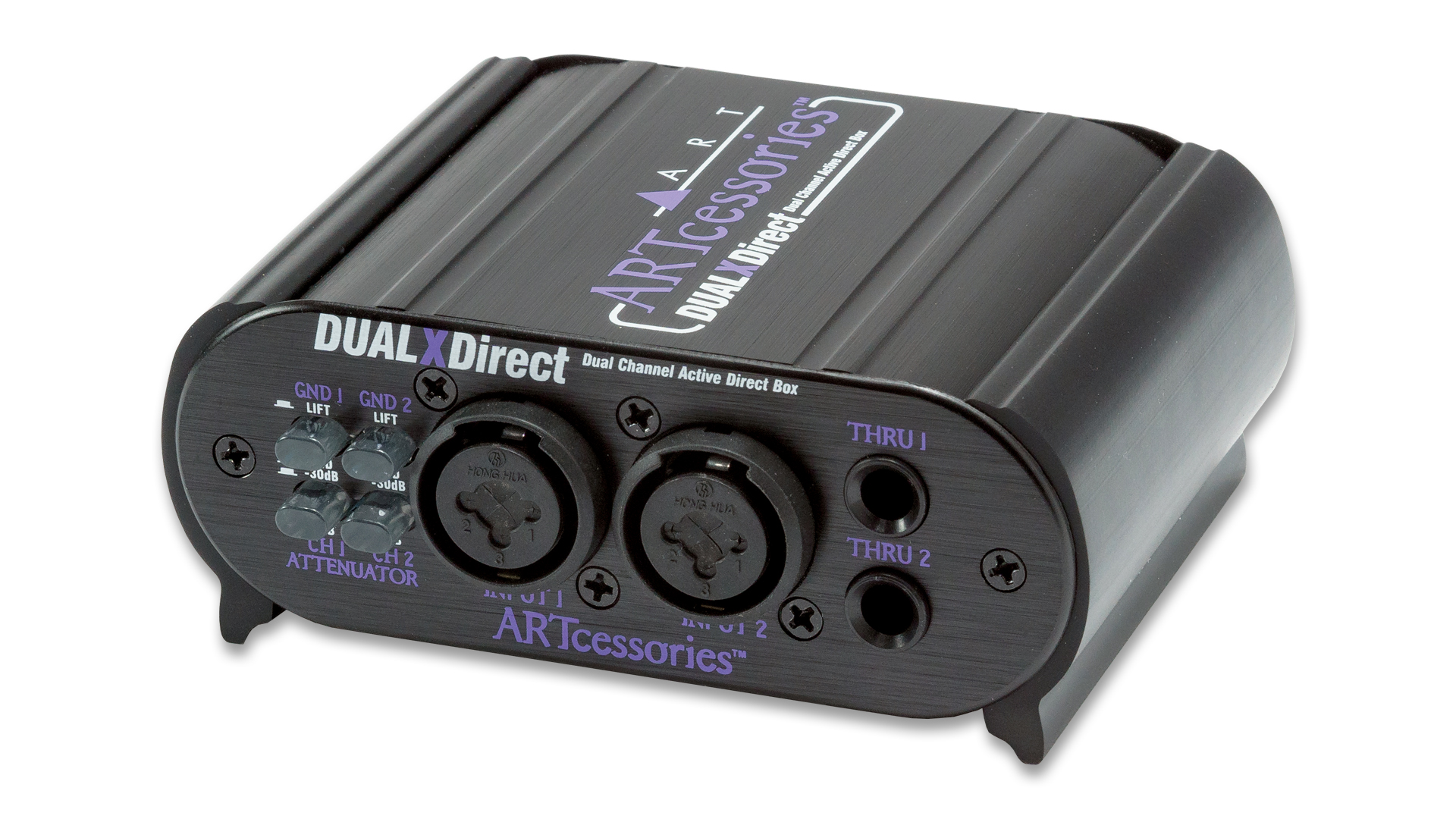


ART DUALXDIRECT Active dual DI box
€78.00*
Prices incl. VAT plus shipping costs
(Free shipping from 49,-€ order value within Germany)

Delivery on request
Can be operated via phantom power or 9V battery
The incoming signal via the high-impedance, unbalanced jack and balanced XLR connectors is
Signal is converted into an isolated, balanced and low impedance signal
Ground lift switch
Compact, black anodised aluminium housing
Frequency response: 10 Hz - 100 kHz, +/- 0.5 dB @ +0 dBu
THD: <0.05% (typical)
Dynamic range: >100 dB (typical)
Channel separation: > 80 dB (typical)
Max. Input level: +4, +34 dBu
Max. Output level: +6 dBu (battery operated), +14 dBu (phantom power operated)
Inputs: 1/4" TRS | XLR female balanced / unbalanced (2), 470k Ohm
Parallel loop-through socket: 1/4" TRS (2)
Outputs: XLR male balanced (2), <600 Ohm
Input attenuation: Switchable, (0, -30 dB)
Power supply: 9V @ 7.5 mA (battery, alkaline), 18 - 48V DC @ 6.4 mA (phantom power per channel)
Dimensions (WDH mm): 99 x 117 x 47
Weight: 0.38 kg
The DUALXDirect provides two independent, high-quality active interfaces that allow you to connect instrument, line or speaker level signals to a mixer or other balanced inputs. Each of the high impedance 1/4" and XLR inputs (provided via "combo" jacks) is buffered and converted to an isolated, balanced, low impedance signal output by very low noise active electronics. The DUALXDirect has an extremely flat and wide frequency response and can handle high signal levels. This gives the DUALXDirect a very clean and neutral sound with a wide range of signal sources and over long signal runs in high noise environments.
The ATTENUATOR input switches allow a wide range of signal levels and the THRU input sockets allow you to monitor your signal chain. The GROUND LIFT switches allow you to completely isolate the input and output signal grounds, if necessary, to isolate two systems and reduce hum and ground loop noise.
The active circuit of the DUALXDirect is powered by the phantom power of the OUTPUT connectors or by an internal 9 V battery if no external power supply is available. When powered by a battery, it consumes less than 7.5 mA, which should ensure an operating time of more than 100 hours with a new battery (alkaline recommended). When phantom power is available, the DUALXDirect automatically draws power from the external source. The POWER ON / OFF switch lights up dimly when the device is empty, lights up brighter when the phantom power is empty and is switched off when the device is inactive.
The compact, black anodised aluminium housing and its active design allow the DUALXDirect to provide years of trouble-free service in live sound, permanent/fixed installation, D.J. and virtually any PA application. The DUALXDirect's full feature set, rugged construction and high-end specifications make it the obvious choice.
Contact:
Teac Europe GmbH
Bahnstraße 12
65205 Wiesbaden
E-Mail: info@teac.eu
Web: https://teac.eu/de/die-zukunft-der-aufzeichnung
Login