RME (Rme Audio) is a German manufacturer of professional audio technology, founded in 1996 and specialising in the development of high-quality audio interfaces, mixing consoles and digital audio solutions. Known for its outstanding sound quality and reliability, RME offers products that are used in both professional recording studios and live applications. The brand has earned an outstanding reputation for its innovative technologies, including its proprietary SteadyClock technology, which ensures precise synchronisation and minimal jitter. RME places great emphasis on ease of use and flexibility, making their products a favourite choice for sound engineers, musicians and producers. With a strong focus on quality and performance, RME remains at the forefront of audio technology, helping creatives realise their musical visions with the highest precision.
The Digiface Dante utilises RME's sophisticated drivers for Windows and Mac OS with the lowest latency and industry-leading stability. With TotalMix FX, not only is flexible routing possible, but you can also mix as many independent submixes as there are outputs available. The high quality headphone output offers fast playback of all audio channels or use it as a line output for an additional analogue stereo mixdown.RME has made the two BNC sockets for word clock I/O switchable to MADI I/O, for up to 64 channels. The sum of Dante and MADI, 128 channels, is transferred via USB 3.0 and handled by the Dante control software and TotalMix FX.Equipped with two banks of redundant network ports, the Digiface Dante is more than just an audio interface. It also offers the functionality of a switch, connecting up to four network linesWithout USB, the Digiface Dante automatically becomes a 64-channel Dante / MADI converter. The analogue stereo output can be pre-configured to output exactly the channels required.Like all current RME interfaces, the Digiface series also features the powerful TotalMix FX digital real-time mixer. It can perform virtually any mixing and routing processes with all inputs and playback tracks on any hardware outputs.The mixer offers a wide range of functions, including a control room section with talkback, main/phones, fader groups, mute groups, complete remote control via Mackie and OSC protocol, and much more. The Digiface series does not support DSP-based effects (FX) such as EQ or reverb.TotalMix Remote, extends the power of RME interfaces by enabling remote control via iOS, PC or Mac. With a straightforward setup process - you simply enter the IP address of the computer you want to control with TotalMix Remote - and instantly every aspect of TotalMix FX can be adjusted on a host system as you walk around the studio with your tablet, regardless of where the control room is located in your facility.
For the 20th anniversary of the legendary Fireface 800, RME presents an exclusive special edition:the Fireface 802 FS AE in an elegant and dark design, inspired by the successful ADI-2 series.The Fireface 802 FS AE is technically identical to the Fireface 802 FS and offers the same powerful features and functions such as 60 audio channelsFeatures and functions such as 60 audio channels, high-end microphone preamps, reference class converters, a complete effects section and operation with up toEffects section and operation at up to 192 kHz. Active SteadyClock FS jitter suppression, DC-coupled outputs for all 8 analogue line outputs, individuallyanalogue line outputs, individually switchable reference levels for all inputs and outputs, full stand-alone functionality,DigiCheck metering and analysis toolbox and identical operation on Windows PC and Mac complete the package.The range of functions also includes the optional Class Compliant mode (full 30-channel I/O with up to 192 kHz) and operation with TotalMix FX for iPadOperation with TotalMix FX for iPad, RME's app for complete control of the Fireface 802 FS AE from the iPad, without a computerComputer. The alternative CC mode can be activated via a recessed button directly on the back of the interfacebe activated. To control TotalMix FX including the latest Room EQ function, users will now find a USB-APort for direct connection of the optionally available ARC USB.
The Fireface UFX III is the centre of any multitrack studio and can handle up to 94 channels of I/O with ease. Its unrivalled flexibility, compatibility, the integration of DURec (Direct USB Recording) and RME's famous low-latency hardware and driver design guarantee flawless operation in any mode and any application.Equipped with professional features such as SteadyClock FS, MADI I/O (64 channels), a powerful DSP, USB 3.0 (full 94 channels I/O Class Compliant ready), TotalMix FX, Direct USB Recording and support for the separately available Advanced Remote Control USB make the Fireface UFX III the preferred professional tool for multitrack recording, mixing and mastering.
Extended infrared remote control with 22 buttons for various functions and commands for maximum flexibilityThe extended remote control for ADI-2 DAC FS and ADI-2 Pro FS R Black Edition offers buttons for standby on/off, adjustment of volume, balance, bass and treble, input selection (optical, coaxial, USB), mute, as well as on/off switching of loudness, bass/treble and EQ.In addition, there are four programmable buttons with access to up to 52 different functions and commands for maximum flexibility. There is no other converter or comparable device with such a sophisticated, easy-to-use and versatile remote control!
The HDSPe MADI card with 128 channels is the most powerful MADI interface from the RME Premium Line. It supports all common MADI formats (56- and 64-channel, single- and double-wire).Compared to the normal PCI card, the PCI Express version offerscard: sample rates up to 192 kHz, lower latency and support for the timecode option (TCO).
The MADIface USB is a particularly compact device, with MADI input and output via USB 2.0 with full 128-channel (64 I/Os) support. The robust design and the numerous RME-typical features, as well as the power supply via USB make it portable, easy to use and reliable in application. SteadyClock and RME's well-known MADI compatibility guarantee trouble-free operation with other devices. The MADI input redundancy of the MADIface USB (SRO mode) ensures stable switching to the other MADI port within just one sample in the event of a failure, thus providing maximum data security for all professional applications. In addition, there is active jitter suppression, RME's unique DIGICheck meter and analysis software (with EBU R128 metering), and almost identical operation under Windows and Mac OS.
The Fireface UCX II is a highly integrated pro audio solution in an ultra-compact format for studio and live use. It follows in the long RME tradition of ultra-compact high-end interfaces that combine features, functionality and quality in a half-19-inch housing, for which other manufacturers require several full rack widthsRack widths.With up to 20 channels for recording and 20 channels for playback, SteadyClock FS, powerful microphone inputs, parametric EQ, dynamics processing, echo, reverb, (DURec) Direct USB Recording, a powerful headphone output and full stand-alone operation, the Fireface UCX II offers the best size-to-functionality ratio yet.
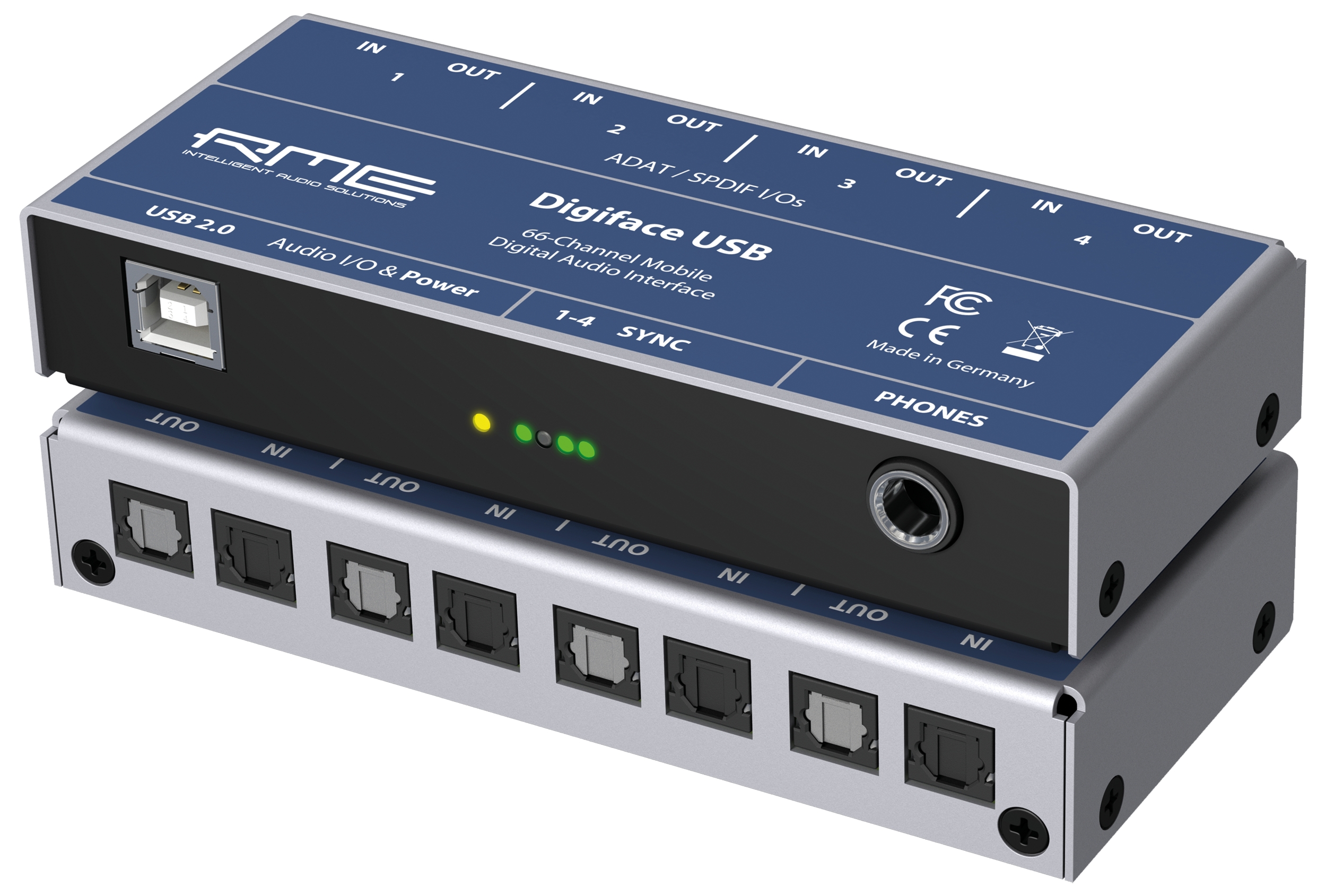
The Digiface USB is an extremely compact, portable digital audio interface with 4 optical ADAT/SPDIF inputs and outputs and a high-quality analogue headphone output (6.3 mm jack). Based on the legendary HDSP Digiface, a triple ADAT I/O interface with headphone and PCI connection, the Digiface USB simplifies the connection via USB2.0, does not require an external power supply and even comes with an additional optical input and output. This gives the Digiface USB a total of four TOSLINK inputs and outputs (64-channel ADAT I/O @48 kHz) and an analogue headphone output. Each individual optical connection can be used either as ADAT (up to 8 channels) or SPDIF (stereo). While the inputs automatically adapt to the incoming signal format, the outputs can be individually switched between ADAT and SPDIF. SMUX and SMUX4 are supported. At 192 kHz, 8 channels are possible via 4 x SPDIF or ADAT as inputs and outputs. Its small size and weight, as well as the power supply via USB, make the Digiface USB extremely versatile, even as a pure headphone amplifier for mobile use.
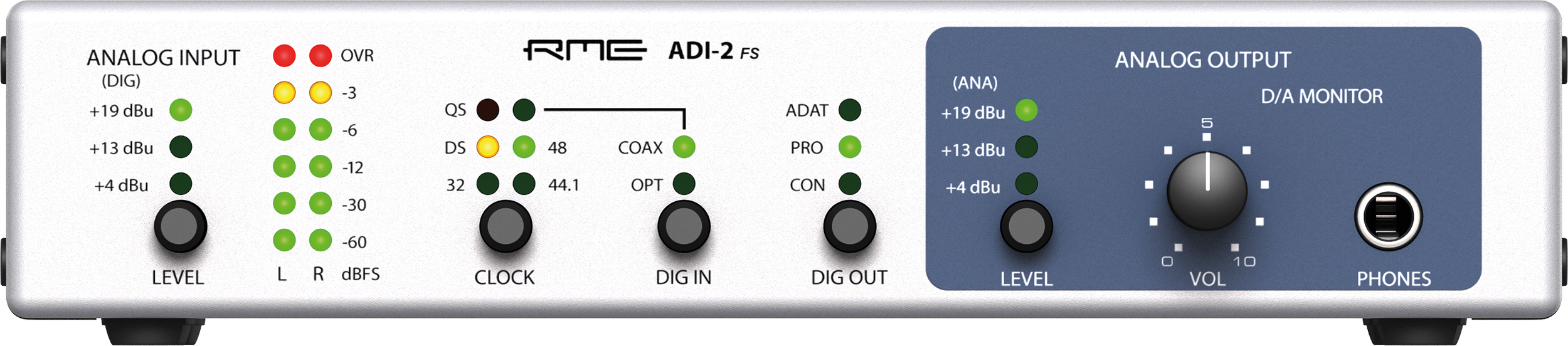
The ADI-2 FS is a compact and extremely flexible 2-channel hi-end AD/DA converter. The device offers first-class AD/DA conversion from/to SPDIF, AES/EBU and ADAT at up to 192 kHz in a half-19 inch housing. Its ability to handle SPDIF, AES/EBU and ADAT equally gives it outstanding compatibility. Whatever it is - just plug it in!Balanced analogue inputs and outputs, monitoring via headphone output, SteadyClock FS for optimum converter function, 3-stage hardware adjustment of input and output levels, as well as the additional D-D and A-A modes make the ADI-2 FS a universal tool and versatile problem solver, which with its exceptional sound quality is also ideal as a complement to other high-quality converters.The ADI-2 FS features two servo-balanced line analogue inputs via XLR/jack combo socket, balanced XLR and unbalanced jack outputs that can be used simultaneously, an adjustable high-power stereo headphone output on the front, an ADAT-compatible optical SPDIF I/O and a coaxial SPDIF (RCA, AES/EBU compatible). These extensive connection options allow high-quality and flexible signal transmission without compromise.The analogue inputs use the exquisite circuit technology of the award-winning ADI-2 Pro, offering excellent noise and distortion values as well as a very wide transmission range. Three different input and output levels are available to guarantee optimum adaptation at the analogue level. The ADI-2 FS also features SteadyClock FS, RME's latest clock technology with minimal inherent jitter and maximum jitter suppression. It guarantees the best sound characteristics of the AD/DA conversion, completely independent of the quality of the reference clock used. The ADI-2 FS also utilises technology from the ADI-2 Pro for the converters: the AK557x family and the AK4490 not only offer 192 kHz sample rate and low distortion, but also a signal-to-noise ratio of 120 dBA.However, the ADI-2 FS not only offers optimum sound, but also optimum digital connectivity. Its coaxial RCA SPDIF I/O is AES/EBU compatible thanks to switchable channel status (cable adapter required). The optical TOSLINK I/Os work up to 192 kHz, and can also be used as ADAT I/Os even at 192 kHz. It is also possible to use SPDIF input with ADAT output or vice versa in AD/DA and D-D mode at any time.The clear font panel layout with unambiguous labelling, functional buttons with informative status displays, a level indicator with 6 LEDs and the tidy rear panel make the device easy to use.
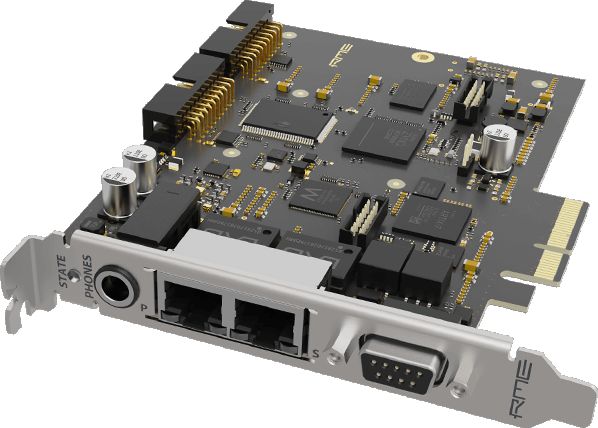
The PCIe x4 audio interface cards HDSPe AoX (AVB) and HDSPe AoX-D (Dante) offer two network connections with headphone output, AES3, MIDI, SteadyClock for all digital input signals and internal expansions for up to four optional MADI connections. Whether in a Thunderbolt expansion chassis or built into DAWs or audio processors, these cards send and receive up to 512 audio channels and offer numerous mixing and routing options via TotalMix.
With 60 audio channels (30 inputs and 30 outputs), support for sample rates up to 192 kHz and the flexibility of the USB connection, the Fireface UFX II is the ideal solution for a wide range of recording, mixing and monitoring applications. The excellent flexibility allows the UFX II to be seamlessly integrated into an almost unlimited number of working environments. Analogue, ADAT, AES, SPDIF and USB-2 are standard on the Fireface UFX II, and the number of channels is just as impressive: 12 analogue, 16 ADAT and 2 AES channels each offer 30 inputs and 30 outputs. Thanks to the USB-2 connection, the UFX II can also be operated with the optionally available RME ARC USB (Advanced USB Remote Control).
RME's Digiface AVB demonstrates how audio can be transferred from PC to network and back again using the AVB protocol stack and now makes this capability available for Windows-based PCs.Equipped with USB 3, you can stream up to 128 audio channels with sampling rates of up to 192 kHz to the AVB network and a further 128 channels back. The channels are organised into configurable streams ranging in size from 2 to 32 channels, allowing connections to all available AVB audio devices on the market.The accompanying software package includes an AVDECC controller that provides essential functions to discover all AVB devices on a network and manage connections of incoming and outgoing data streams. Basic monitoring functions are built in.Like all current RME interfaces, the Digiface series also features the powerful TotalMix FX digital real-time mixer. It can perform virtually any mixing and routing processes with all inputs and playback tracks on any hardware outputs.The mixer includes a wide range of functions, such as a control room section with talkback, main/phones, fader groups, mute groups, complete remote control via Mackie and OSC protocol, and much more. The Digiface series does not support DSP-based effects (FX) such as EQ or reverb.TotalMix Remote, extends the power of RME interfaces by enabling remote control via iOS, PC or Mac. With a straightforward setup process - you simply enter the IP address of the computer you want to control with TotalMix Remote - and instantly every aspect of TotalMix FX can be adjusted on a host system as you walk around the studio with your tablet, regardless of where the control room is located in your facility.
The HDSPe MADI FX sets a new milestone among RME audio interfaces. Never before has there been such a powerful and high-performance multi-channel computer interface.390 channels! Three MADI I/Os - two optical and one coaxial - are accompanied by an AES/EBU I/O and an analogue monitor output. There is also a word clock I/O and a total of four MIDI I/Os. As is typical for RME, all the technology and connections are concentrated in a very small space. Only one PCIe slot on the motherboard and a second free slot on the computer are required.To guarantee RME's worldwide unique low-latency performance even with so many channels, a new, modular high-tech audio core has been developed, which processes more than three times the number of channels of the previous RME MADI flagship and requires an even lower system load. Assuming a powerful computer, record-breaking latencies of up to 32 samples can be utilised even when using all 390 channels. Sophisticated efficiency technology automatically switches off channels that are not currently being used in the hardware so that they do not require any computing power. A simple stereo signal does not place a greater load on the computer than a simple stereo card - despite a professional multi-channel system with almost 400 channels!The new core technology goes hand in hand with a special TotalMix FX version in order to utilise the enormous number of channels efficiently and practically. In addition to numerous performance optimisations, which make the 4096-channel mixer of the MADI FX react just as smoothly as its Fireface UFX counterpart (1800 channels), and a faster DSP for a higher number of EQs and compressors, this primarily affects the manageability of the sheer mass of channels. A new hide technology makes it possible to hide unused channels visually. Hide setups can be saved and loaded at any time, for example to switch between displaying the drum mix and the complete band mix at the click of a mouse.
This wired remote control was developed for direct access to the most frequently used functions and commands of TotalMix FX, as an indispensable tool in daily studio practice. The extremely flexible configuration options simplify the workflow and significantly increase the usefulness of the RME interface in most applications.The ARC USB is a USB 1.1 (UAC1) MIDI remote control, directly compatible with Windows and Mac OS X. As soon as it appears in the operating system, it is detected by TotaIMix FX and communicates with TotalMix FX without interfering with MIDI or other remote controls. Therefore, it is not necessary to switch the ARC USB on or off in TotalMix FX, it will work just like that. And since it communicates with TotalMix FX (via USB) it is compatible with all RME audio interfaces that are recognised and supported by TotalMix FX. This goes all the way back to RME interfaces from 2001!As soon as an ARC USB is connected to a computer, every press of a button and every turn of the knob causes a corresponding reaction in TotalMix FX - and therefore also from the RME audio interface used.With the UFX+ and UFX II, the ARC USB can also be connected directly to the device instead of to the computer, as these two are the only RME interfaces so far to have an internal USB 1.1 host with a suitable socket. This type of connection is particularly useful in stand-alone operation, where the UFX+ and UFX II also support the ARC USB.The ARC USB is bus-powered, but draws comparatively little power. It also only uses USB 1.1, which is completely uncritical nowadays due to the low frequency and low speed requirements. USB2 cables with a length of 5 to 10 metres, or cheap USB2 cable extensions, which cause some bus-powered devices to malfunction, work with the ARC USB. Nevertheless, RME recommends the use of active USB 2 cables (also called extension or repeater cables) for longer lengths, which are not expensive and guarantee correct function at 20 metres and more.The ARC USB also controls several audio interfaces simultaneously. It is configured via the Key Commands dialogue in TotalMix FX. This dialogue applies to the selected audio interface. Simply assign each interface only the functions that it should have on the ARC USB. The buttons and the rotary encoder of the ARC USB then control the interface for which they have been configured without having to switch or select anything during normal operation.
The PCIe x4 audio interface cards HDSPe AoX (AVB) and HDSPe AoX-D (Dante) offer two network connections with headphone output, AES3, MIDI, SteadyClock for all digital input signals and internal expansions for up to four optional MADI connections. Whether in a Thunderbolt expansion chassis or built into DAWs or audio processors, these cards send and receive up to 512 audio channels and offer numerous mixing and routing options via TotalMix.
With the HDSPe AIO Pro PCI-Express interface card, RME presents the successor to the successful HDSPe AIO. The HDSPe AIO Pro is a 1:1 replacement in terms of functions (number of channels, I/Os).Notes: The new HDSPe AIO Pro does not support sample rates higher than 192 kHz or DSD. The basic functions have not changed compared to the HDSPe AIO. The card no longer supports AI4S-192/AO4S-192 (TCO/WCM is still supported)
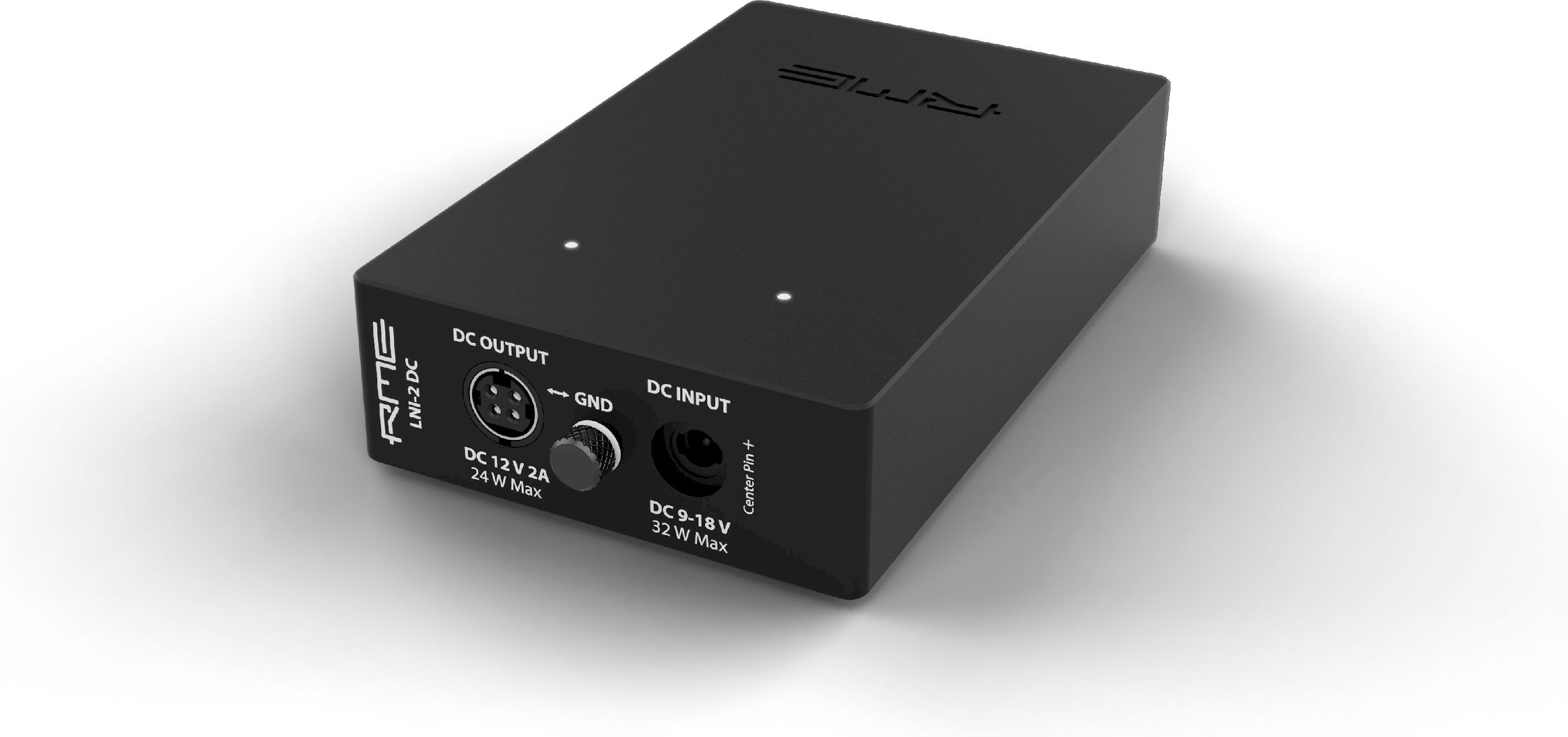
With the LNI-2 DC, RME presents an active DC filter in a compact and portable housing. The LNI-2 DC separates, regenerates and filters the output signal of any 12 volt DC power supply, thereby ensuring a significant improvement in DC voltage stability and an extremely clean 12V voltage supplysupply. The result is an optimised audio signal and sound without hum, buzz and other noise that can occur from both power supplies and a contaminated mains supply.The LNI-2 DC's operation is based on two key features: galvanic isolation and RME'sexclusive filter. The galvanic isolation significantly reduces the leakage current component that is common in switching power supplies, while at the same time the capacitive coupling between input and output is reduced from typically 1 nF (nano-farad) to less than 35 pF (pico-farad) to prevent noise caused by the leakage current.The filter of the LNI-2 DC consists of a discrete linear regulator with extremely low noise (only a few micro-volts), soft-start, overload and overheating protection as well as sensor technology.The LNI-2 DC works with power sources from 9V-18V DC (input) and always delivers a constant, perfect voltage of 12.0V with 2A at its lockable output. This is ensured by the filter's integrated sensor technology, which checks and compares the output voltage directly at the DC plug of the special 4-core cable supplied, thus completely eliminating load-dependent voltage drops.The two two-colour status LEDs on the top of the device indicate the presence of input and output voltage as well as overload. In addition, it is possible to connect the earth of the DC voltage output to the protective conductor, earth or another device earth via an earthing screw (GND screw terminal) in order to solve problems with the earth wiring.
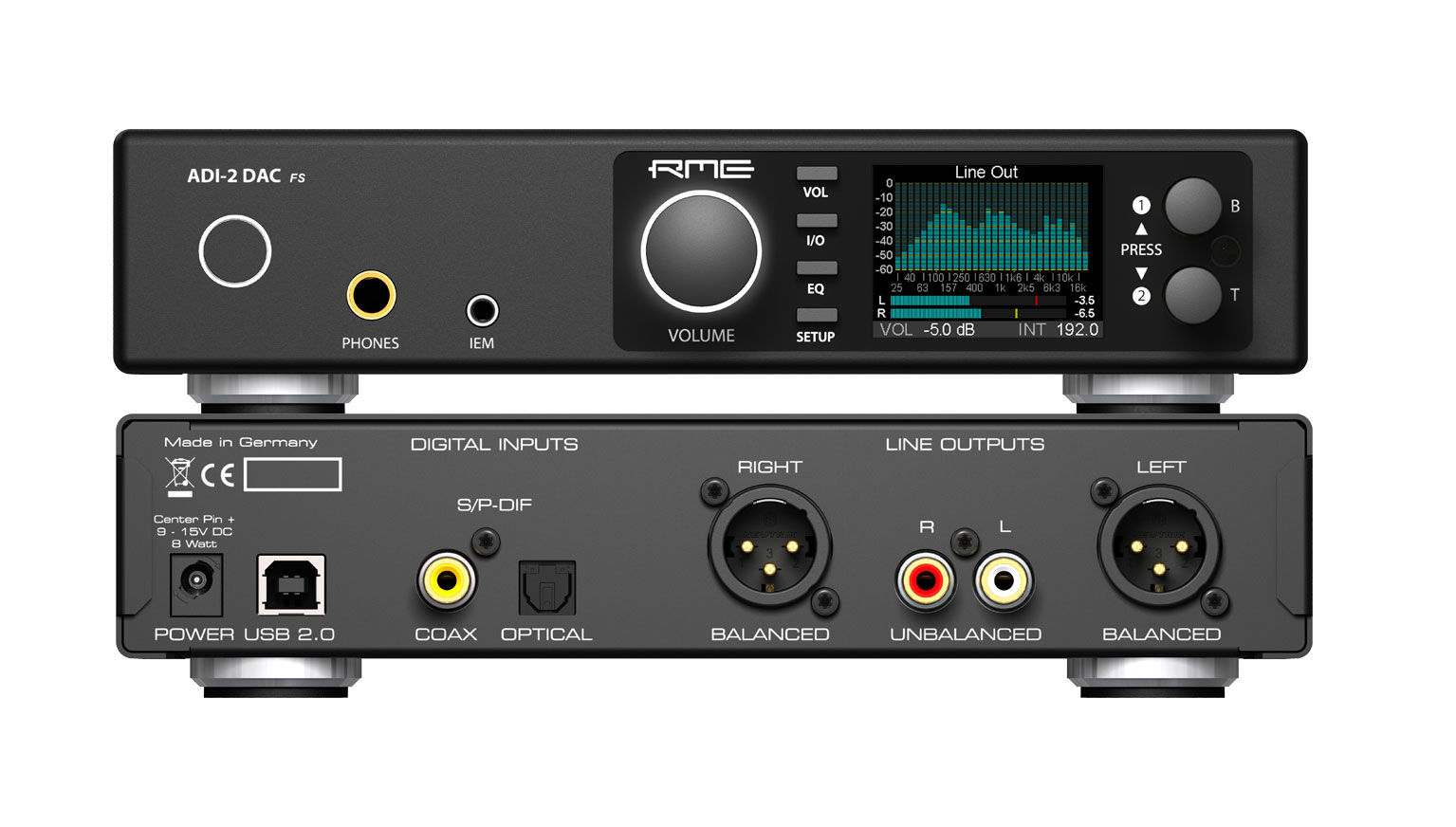
The ADI-2 DAC offers an improved SteadyClock, analogue circuitry tuned to perfection, the new MRC remote control, an Extreme Power headphone output and a special IEM output. It has all the special features that have made the ADI-2 Pro famous, above all its completely transparent sound and the sophisticated DSP processing with bass, treble, loudness, parametric 5-band EQ, crossfeed and much more. With its simplified operation and breathtaking design, it is the ideal centrepiece for the listener at home through to reference playback in the studio.The ADI-2 DAC is the version of the ADI-2 Pro, a studio AD/DA converter of the highest quality, optimised and adapted for home and hi-fi users. Packed with fresh ideas, innovative features and numerous useful functions, the ADI-2 DAC quickly became a reference. Thanks to its combination of high-end DA conversion with two exceptional headphone IEM outputs and a remote control, it has received countless rave reviews for its sound, flexibility and technical capabilities.The latest version of the ADI-2 DAC comes with an extended remote control, a further improved DA conversion and an adapted analogue output stage for even better noise and distortion values. To better appeal to home and hi-fi users, RME replaced some of the studio features with typical features of hi-fi devices. Equipped with a customised and extended range of functions and simplified operation, RME now presents the ADI-2 DAC. It is based on the technology, concept and functions of the ADI-2 Pro, but focusses on DA conversion in highest high-end quality, combined with two exceptional headphone and IEM outputs.Packaged in a compact 9.5 inch format, this little gem is equipped with the finest high-end electronics and offers reference conversion from SPDIF coaxial, SPDIF optical (ADAT compatible) and USB to RCA, XLR, TRS and mini jack.As the most flexible DAC on the market today, the ADI-2 DAC offers balanced and unbalanced analogue outputs, an Extreme Power headphone output, an ultra-low noise IEM output, SteadyClock FS, 4-stage hardware output level adjustment, DSP-based signal processing, external power supply, Class Compliant USB compatibility, sample rates up to 768 kHz and DSD playback. The SPDIF input signal can even be recorded via USB - as you would expect from RME, the DAC is a true 2-channel full-duplex audio interface.Improved DA conversionThe updated ADI-2 DAC utilises ESS ES9028Q2M in a special circuit variant developed by RME engineers, which allows the chip to perform at its best. Be it a signal-to-noise ratio of 123 dBA, distortion lower than -120 dB, or THD+N of -116 dB, the device delivers outstanding measured values. The IEM output achieves a sensationally low noise floor of -121 dBu. In addition, there is 2.5 dB of digital headroom, so that inter-sample peaks do not produce any audible distortion. The device also offers a significant reserve in the volume setting. +2.5 dB still results in an undistorted analogue output signal.There are no significant changes to its predecessor in terms of operation, features and behaviour, which is why neither the appearance nor the name have changed. All differences are explained in the detailed ADI-2 DAC manual.Even lower noise for IEM loversThe ongoing trend towards headphones has brought increased attention not only to conventional headphones, but also to IEMs (in-ear monitors) among audiophiles and music lovers. Modern IEMs have a reference quality sound that can easily compete with bulky over-ear headphones, making them not only a mobile alternative but also an interesting solution for the home.Modern IEMs are extremely sensitive and operate at very low voltages. As a side effect, however, they often make the background noise of the player, DAC or headphone amplifier audible. During the development of the Extreme Power headphone circuit, care was taken to keep the noise floor as low as possible. This has been confirmed in many tests (deep black background...). Even when using IEMs.Nevertheless, RME wanted to ensure that even the most sensitive IEM would deliver the full dynamic range to the ears of the most sensitive music listener. Also, high-quality outputs like the Extreme Power are not immune to operating errors and could overstrain ears like IEMs.RME's solution: add the most advanced IEM output imaginable as a second headphone output on the front of the ADI-2 DAC. Its noise floor is an astonishing 10 dB lower than that of the Extreme Power output (black hole...), the output impedance is close to zero ohms and the THD value reaches new record lows. Click-free on/off switching is just as much a matter of course as volume ramp-up, and the sound quality with every IEM is simply incredible. We are sure you will be thrilled!