Skip to main content Skip to search Skip to main navigation

SPL

Contact:

SPL electronics GmbH
Sohlweg 80
41372 Niederkrüchten

E-Mail: info@spl.audio
Web: http://www.spl.info
Filter products

SPL MixDream
SPL MixDream
card.manufacturer:
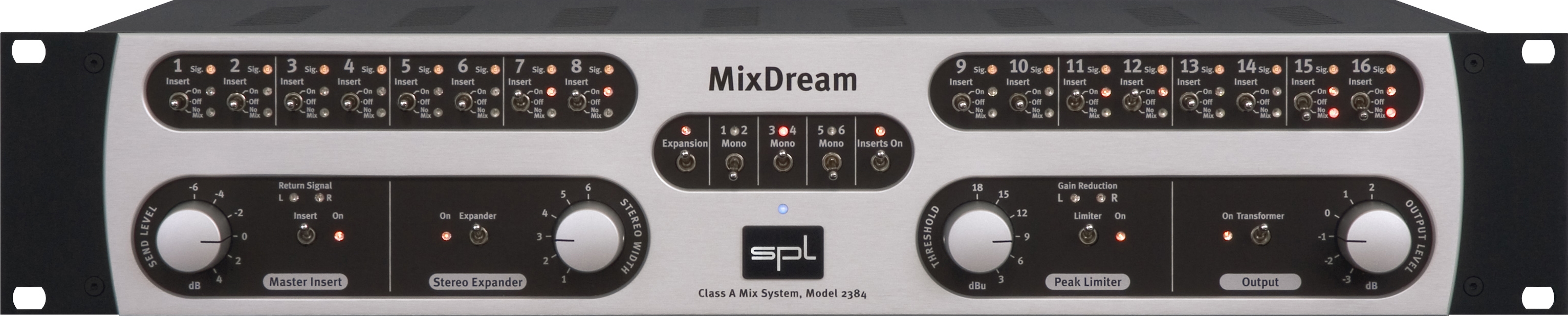
The MixDream allows both the central integration of analogue equipment into digital production environments and stereo summing, i.e. the mixing of audio tracks on an analogue level.Conceptually, the reduction to high-quality analogue summing without panorama controls and faders offers the great advantage of being able to retain the entire computer automation. A MixDream can sum 16 audio tracks to one stereo signal. If more than 16 tracks are to be summed, any number of MixDreams can be operated together.The MixDream is based on discrete Class A technology with 60-volt operation (+/-30V). Newly developed circuits based on the latest analogue components ensure extremely high slew rates, a low noise level of -97dBu (A-weighted, 16 channels open) and a high dynamic range of over 125dB. The MixDream therefore easily reaches the technical level of the best consoles.

€2,998.00
SPL PassEQ
SPL PassEQ
card.manufacturer:
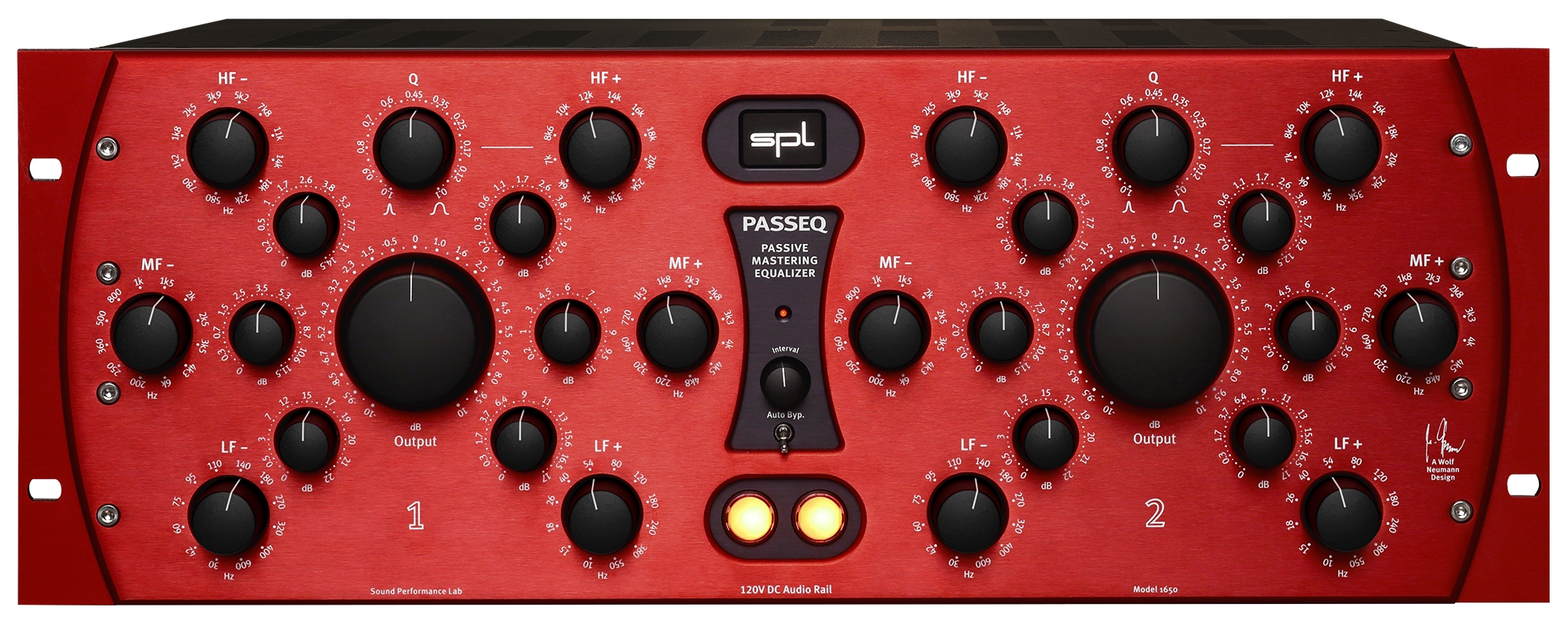
The first generation Passeq was the first passive equaliser to provide three separate frequency ranges for boost and cut. With 12 switchable frequencies per band, i.e. 36 frequencies for the cut and 36 frequencies for the boost, the Passeq was the most powerful passive EQ filter network of all time. The same number of boost and cut frequencies is now also available with the new PASSEQ Mastering Equaliser. However, the selection of frequencies has been changed and the Q factor, or quality factor, has been individually re-tuned for each selectable frequency using an optimised coil, capacitor and resistor combination. Each boost and cut frequency now has an individually optimised Q factor.The entire passive filter (variable resistor, capacitor and coil) delivers a very nice sound characteristic. In addition to the choice of components, the charging behaviour of the capacitors and the saturation behaviour of the coils play a major role in this. The resulting relative inertia compared to potentially very fast active filters is the reason for a pleasant, musically favourable sound characteristic. We would choose smoothness and transparency as well as strikingly silky highs and pithy basses as a suitable description for our perception.During fine-tuning, through component selection, in countless listening sessions, the focus was on achieving the most musical sounding curves possible, which need not shy away from comparison with a Pultec EQ from the 1950/60s, for example. But without all the disadvantages of a 60-year-old original, such as the very high noise floor, but above all the very limited frequency selection.The mid-range bands in particular are now tuned more harmonically for sum processing than on the previous model. The mid range cut band now starts working from 200Hz. We have had new coils specially made for this purpose.Another highlight of the new PASSEQ is therefore the HF+ band, which has been extended by the frequencies 25kHz and 35kHz and sounds so incredibly good that you won't want to switch it off.The output level can now be raised or lowered by 10dB using the large rasterised output control in order to address subsequent devices at the perfect working level. This is particularly important for use in mastering.The gain, Q (HF +) and output parameters of the PASSEQ mastering equaliser can be set in 41 steps using rasterised potentiometers (ALPS RK27 "big blue"). All other parameters are switched via 12-position switches. A perfect recall of all settings is therefore easy to realise thanks to these switches and the detented potentiometers,As with all new SPL mastering devices, the new PASSEQ also features auto baypass. Each of the two channels can of course be deactivated or activated manually using the large illuminated buttons. However, thanks to the auto bypass, this can also be done automatically in a freely selectable time window.

€3,749.00
SPL Crescendo
SPL Crescendo
card.manufacturer:
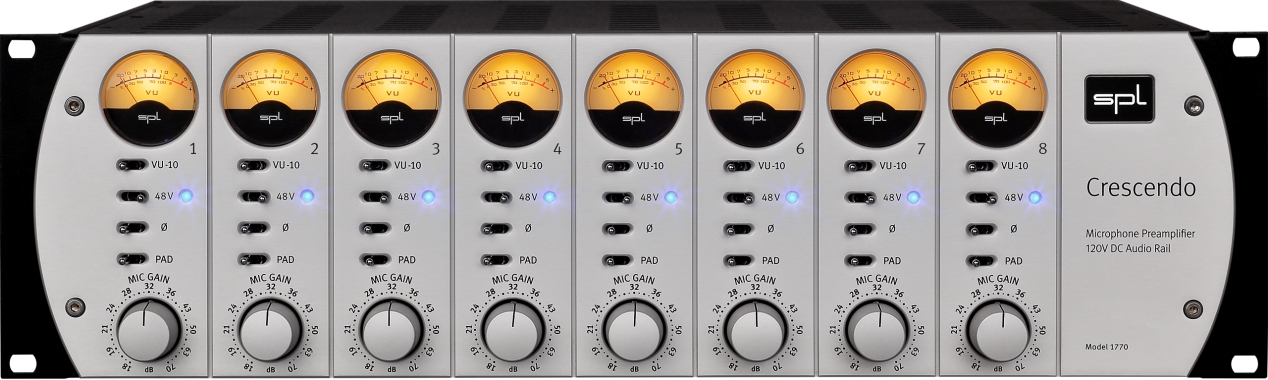
The Crescendo is the first microphone preamplifier to work with an internal operating voltage of 120V.This makes it absolutely unique, as the 120V technology means that this preamplifier is virtually impossible to overdrive. The Crescendo shines with absolute signal fidelity and clarity. Rediscover your microphones, because they have never been amplified like this before.

€4,999.00
SPL PassEQ
SPL PassEQ
card.manufacturer:
The first generation Passeq was the first passive equaliser to provide three separate frequency ranges for boost and cut. With 12 switchable frequencies per band, i.e. 36 frequencies for the cut and 36 frequencies for the boost, the Passeq was the most powerful passive EQ filter network of all time. The same number of boost and cut frequencies is now also available in the new PASSEQ Mastering Equaliser. However, the selection of frequencies has been changed and the Q factor, or quality factor, has been individually re-tuned for each selectable frequency using an optimised coil, capacitor and resistor combination. Each boost and cut frequency now has an individually optimised Q factor.The entire passive filter (variable resistor, capacitor and coil) delivers a very nice sound characteristic. In addition to the choice of components, the charging behaviour of the capacitors and the saturation behaviour of the coils play a major role in this. The resulting relative inertia compared to potentially very fast active filters is the reason for a pleasant, musically favourable sound characteristic. We would choose smoothness and transparency as well as strikingly silky highs and pithy basses as a suitable description for our perception.During fine-tuning, through component selection, in countless listening sessions, the focus was on achieving the most musical sounding curves possible, which need not shy away from comparison with a Pultec EQ from the 1950/60s, for example. But without all the disadvantages of a 60-year-old original, such as the very high noise floor, but above all the very limited frequency selection.The mid-range bands in particular are now more harmonically tuned for sum processing than on the previous model. The mid range cut band now starts working from 200Hz. We have had new coils specially made for this purpose.Another highlight of the new PASSEQ is therefore the HF+ band, which has been extended by the frequencies 25kHz and 35kHz and sounds so incredibly good that you won't want to switch it off.The output level can now be raised or lowered by 10dB using the large rasterised output control in order to address subsequent devices at the perfect working level. This is particularly important for use in mastering.The gain, Q (HF +) and output parameters of the PASSEQ mastering equaliser can be set in 41 steps using rasterised potentiometers (ALPS RK27 "big blue"). All other parameters are switched via 12-position switches. A perfect recall of all settings is therefore easy to realise thanks to these switches and the detented potentiometers,As with all new SPL mastering devices, the new PASSEQ also features auto baypass. Each of the two channels can of course be deactivated or activated manually using the large illuminated buttons. However, thanks to the auto bypass, this can also be done automatically in a freely selectable time window.

€3,749.00
SPL Mercury
SPL Mercury
card.manufacturer:
We have looked at many converter designs and asked ourselves why innovations take place almost exclusively on the digital level and only very rarely on the analogue side. Perhaps it is because most developers have their background in digital technology and therefore tend to develop analogue technology according to the 'cookbook'.We have 30 years of experience in analogue technology and we find cookbook designs rather boring, inefficient and in need of improvement.The output of the DAC IC (AK4490) is an analogue signal that needs to be filtered with a low-pass filter. This analogue circuit is typically operated with the same voltage as the DAC IC - for example 5V. Imagine that the first stage that finds the analogue signal has a dynamic range and signal-to-noise ratio limited by this voltage. What a bottleneck.In the Mercury, our 120V technology is used instead of the standard technology. And it does so twice in the newly developed DLP120 module. DLP stands for "Dual Low Pass". These are two separate analogue filters using 120V technology. Depending on the type of digital signal, the analogue signal passes through the PCM or DSD filter and can freely unfold into a huge dynamic range. This is audibly better.The DA converter (DAC) in the Mercury is the AK4490 Velvet Sound® converter chip from AKM. This offers a bit depth of 32 bits and a maximum sampling rate of 768 kHz for PCM digital signals and DSD4 or DSD256 for direct stream digital signals.

€2,675.00
SPL Gemini
SPL Gemini
card.manufacturer:
Gemini is the first M/S mastering processor in 120V technology. Gemini introduces M/S processing to the SPL Mastering series. Gemini is an M/S encoder and decoder. Centre signals (voice, snare, bass ...) can be cleanly separated from spatial side signals (guitars, pads, cymbals ...) in a stereo mix and processed individually. When mastering the sum signal, M/S encoding is often the best way to gain targeted access to individual elements in a mix.Gemini also offers the option of editing the stereo panorama. The balance control can be used to shift the centre signal in the stereo panorama. The Trim control can be used to change the level of the centre signal in relation to the side signal. In conjunction with the Stereo Width control, the mixing ratio of both channels can be changed. An elliptical filter for cutting the low-frequency component of the sideband is also on board.

€2,460.00
SPL PQ
SPL PQ
card.manufacturer:

€6,490.00
SPL PQ
SPL PQ
card.manufacturer:

€6,399.00
SPL Electronics - HPm
card.manufacturer:

€369.00
SPL Iron
SPL Iron
card.manufacturer:
The IRON is a newly developed mastering compressor. The aim was to create a tube compressor with a pleasant, melodious, transparent compression behaviour, inspired by the classics of the early days and further developed to be perfectly adapted to the requirements of modern productions. The IRON not only combines the general sonic advantages of legendary vintage tube compressors with the benefits of the high-dynamic 120V operating voltage in one device, but also takes tried-and-tested tube compressor technology to a new level thanks to the innovative parallel connection of two different tubes. The IRON sets new standards not only in mastering. Another possible application is the processing of individual instruments such as speech, vocals, basses, guitars and strings etc.. The IRON is also ideal for subgroup applications.

€5,899.00
SPL Hermes
SPL Hermes
card.manufacturer:
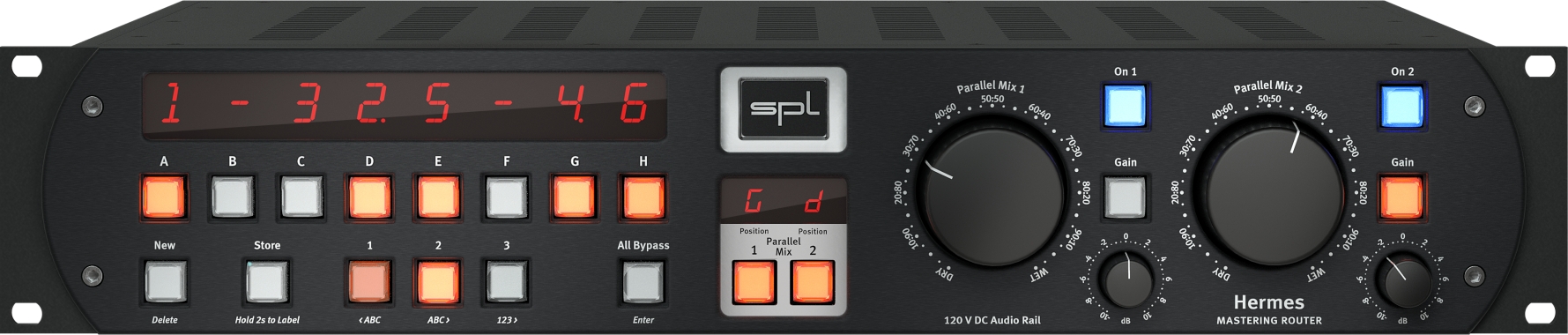
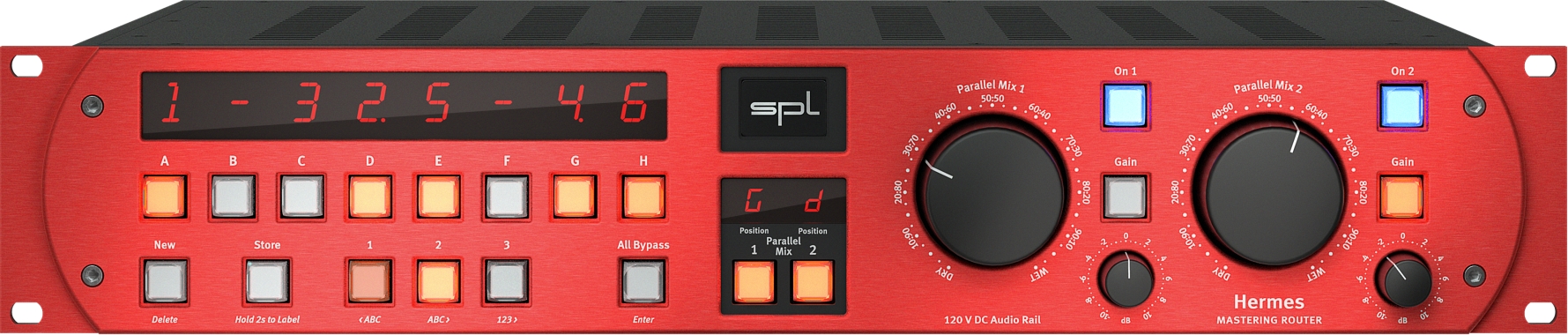
Hermes is revolutionising mastering. It is now possible to have an audio signal processed by up to eight 2-channel processors in any order that can be saved. You can compare up to four complex processing chains at the touch of a button. Hermes also has two freely assignable parallel mix stages, which can be assigned to each of the eight processors and saved with a processing chain. This means that two compressors with different parallel mix settings can also be compared.The routing is completely passive with gas-encapsulated and gold-vapour-plated high-end relays. All active stages, such as the input/output stages and the parallel mix stages, work with SPL's own 120V technology.Hermes speeds up mastering workflows in a way that was previously difficult to achieve and maximises the use of existing equipment. The time-consuming re-plugging alone had made real comparative listening almost impossible. Now you can change, save and compare processing chains in a matter of seconds. All with real buttons, relays and without additional software.

€4,990.00
SPL Marc One
SPL Marc One
card.manufacturer:
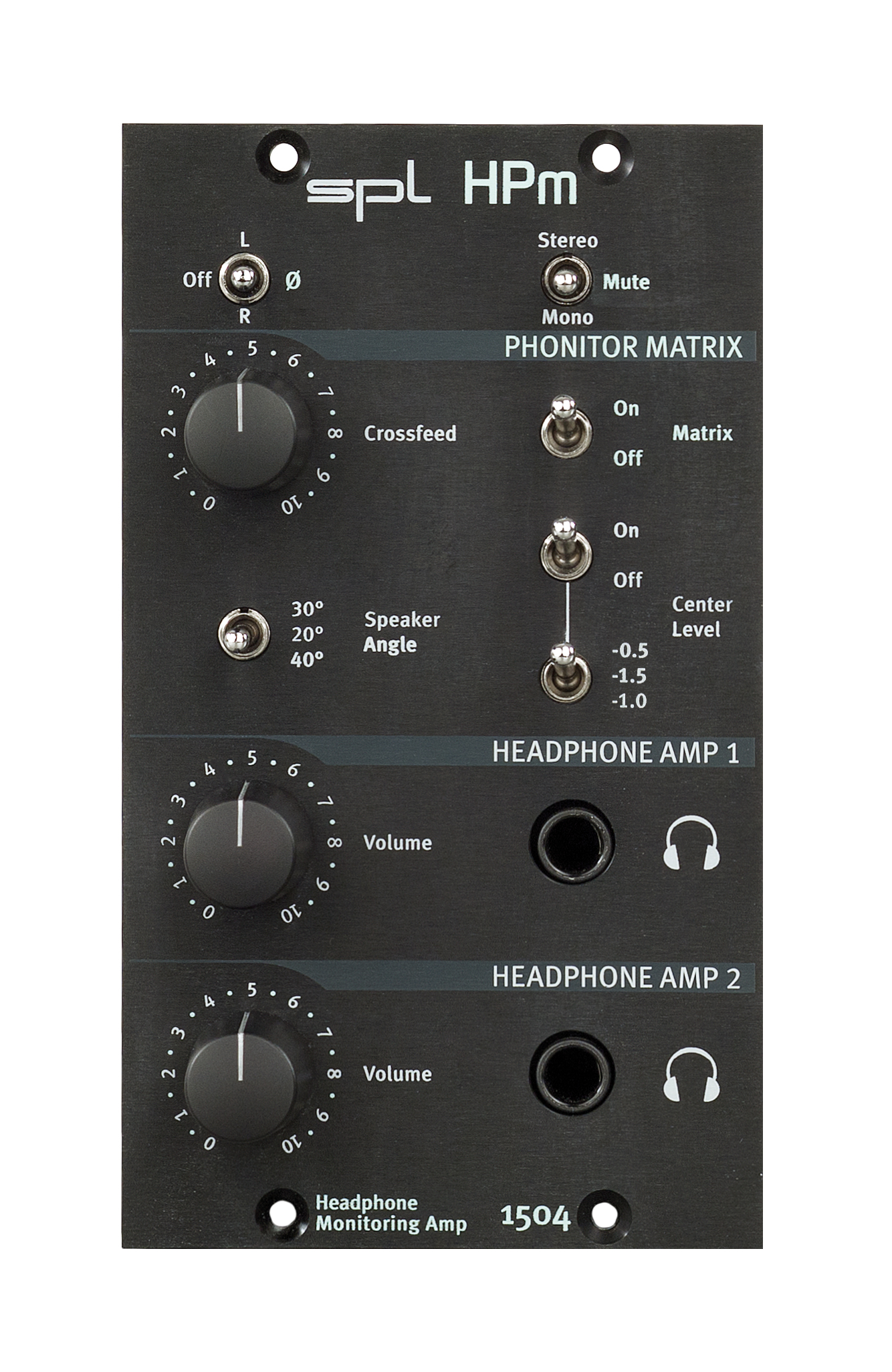
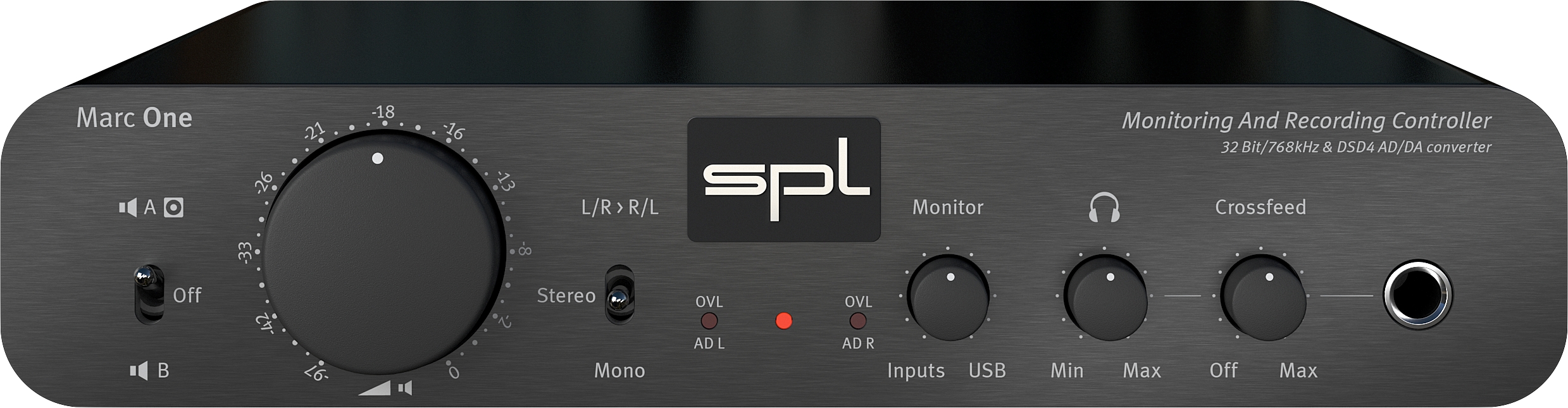
You can monitor your production via two switchable speaker pairs. A subwoofer is also switched on and off with speaker pair A.When the switch is in the centre position, the speakers are switched off, which is practical because you don't have to turn the volume control back.You can adjust the volume ratios at lightning speed using the monitor control. In the centre position, all input signals are equally loud. To the left, the analogue stereo inputs are louder and the USB input signal is quieter. Turned from the centre to the right, the reverse happens. This allows you to set the correct volume ratios quickly and intuitively.Two analogue stereo inputs and one digital USB input can be connected to the Marc One. The DAW (Digital Audio Workstation) is preferably connected via USB.Other players such as CD players, mixing consoles, synthesizers or an analogue tape machine/tape deck can be connected to the analogue line inputs.The converter chip used is the premium AK4490, which belongs to the new generation of premium 32-bit DACs and is equipped with AKM's Velvet Sound®. This technology makes the finest details audible thanks to the low-distortion architecture.Sampling frequencies of up to 768 kHz PCM (16 times CD resolution) and DSD (Direct Stream Digital) playback up to a resolution of DSD4 or DSD256 (11.2 MHz) are supported.This qualifies the Marc One for the highest resolution audio playback currently available.The USB connection is Class Compliant. This means that all Mac computers and iOS devices such as iPads and iPhones can utilise the full performance bandwidth of the AD/DA converter without installing a driver. iOS devices require the Camera Adapter. A driver is required for Windows, which you can download at the bottom of this page.The selected input signal is output unchanged at the Line Out. This means that the Marc One can be looped between devices without "losing" an output.If, for example, several people are to listen in via headphones, a headphone amplifier or a headphone distribution amplifier can simply be connected to the Line Out.You can also record the signal in analogue form or send it to a mixer for further processing.The Marc One offers three monitoring modes. The default setting in the centre is "Stereo". To check the mono compatibility, set the switch to "Mono". The special feature is the channel swap function: L/R > R/Lreverses the stereo image. L/R becomes R/L. This is particularly important and extremely time-saving if you are looking for samples in the video dubbing that should match a scene with a direction of movement.If the direction is not correct, you normally have to load the sample into the DAW for channel swapping and swap the channels there before you can hear and judge whether the sample matches the picture.With the L/R > R/L function, this is no longer necessary. You can now swap the direction of movement in the sample library during pre-listening.The output stage of the headphone amplifier is designed as a push-pull amplifier in Class AB operation. The bipolar transistors share the amplification of the positive and negative half-wave, which produces a higher amplification and a higher output voltage than in Class A operation, in which only one transistor amplifies both half-waves.The output stage transistors are thermally coupled and therefore run particularly coherently, which contributes to a consistent and stable sound image.The power supply has a buffer circuit with low source resistance and thus ensures generous current reserves even when operating low-impedance headphones.The Phonitor Matrix has three setting parameters in the largest configuration: Crossfeed, Speaker Angle and Centre Level.In the Marc One, the centre level is preset to -1 dB and the speaker angle to 30°. These are the most commonly used values.The crossfeed function determines the crosstalk between the channels, the so-called interaural level difference. The intensity of the crossfeed is infinitely variable.At the beginning of the control path, the function is not in the audio path. It is only switched on by adding it via a relay (hysteresis circuit). The audio signal therefore does not pass through the crossfeed stage if this is not desired.

€849.00
SPL Hermes
SPL Hermes
card.manufacturer:
Hermes is revolutionising mastering. It is now possible to have an audio signal processed by up to eight 2-channel processors in any order that can be saved. You can compare up to four complex processing chains at the touch of a button. Hermes also has two freely assignable parallel mix stages, which can be assigned to each of the eight processors and saved with a processing chain. This means that two compressors with different parallel mix settings can also be compared.The routing is completely passive with gas-encapsulated and gold-vapour-plated high-end relays. All active stages, such as the input/output stages and the parallel mix stages, work with SPL's own 120V technology.Hermes speeds up mastering workflows in a way that was previously difficult to achieve and maximises the use of existing equipment. The time-consuming re-plugging alone had made real comparative listening almost impossible. Now you can change, save and compare processing chains in a matter of seconds. All with real buttons, relays and without additional software.

€4,990.00
SPL Track One MK III
card.manufacturer:

€1,099.00
SPL Phonitor One d
SPL Phonitor One d
card.manufacturer:
Two Burr-Brown OPA 2134 SoundPlus™ operational amplifiers take care of the pre-amplification. These have been specially developed for audiophile circuits and are characterised by extremely low noise and minimal distortion of just 0.00008%.Thanks to a genuine FET stage, the OPA2134 achieves a slew rate of 20V/µs, making it a high-speed operational amplifier. This has an immediate positive effect on the liveliness and joy of playing.Furthermore, low-capacitance film capacitors are installed in the signal path as bypass capacitors for the coupling capacitors, which ensures more precise transmission of the high-frequency signal components.The excellent Panasonic 'Electric Double Layer' gold electrolytic capacitors are used as coupling capacitors. They offer the highest storage capacity of all capacitor technologies.The output stage of the headphone amplifier is designed as a push-pull amplifier in Class AB operation. The bipolar transistors share the amplification of the positive and negative half-wave, which produces a higher amplification and a higher output voltage than in Class A operation, in which only one transistor amplifies both half-waves.The output stage transistors are thermally coupled and therefore run particularly coherently, which contributes to a consistent and stable sound image.The power supply has a buffer circuit with low source resistance and thus ensures generous current reserves even when operating low-impedance headphones.The Phonitor Matrix has three setting parameters in the largest configuration: Crossfeed, Speaker Angle and Centre Level.In Phonitor One d, the centre level is preset to -1 dB and the speaker angle to 30°. These are the most commonly used values.The crossfeed function determines the crosstalk between the channels, the so-called interaural level difference. The intensity of the crossfeed is infinitely variable.At the beginning of the control path, the function is not in the audio path. It is only switched on by adding it via a relay (hysteresis circuit). The audio signal therefore does not pass through the crossfeed stage if this is not desired.

€719.00
SPL Phonitor One
SPL Phonitor One
card.manufacturer:
Two Burr-Brown OPA 2134 SoundPlus™ operational amplifiers take care of the pre-amplification. These have been specially developed for audiophile circuits and are characterised by extremely low noise and minimal distortion of just 0.00008%.Thanks to a genuine FET stage, the OPA2134 achieves a slew rate of 20V/µs, making it a high-speed operational amplifier. This has an immediate positive effect on the liveliness and joy of playing.Furthermore, low-capacitance film capacitors are installed in the signal path as bypass capacitors for the coupling capacitors, which ensures more precise transmission of the high-frequency signal components.The excellent Panasonic 'Electric Double Layer' gold electrolytic capacitors are used as coupling capacitors. They offer the highest storage capacity of all capacitor technologies.The output stage of the headphone amplifier is designed as a push-pull amplifier in Class AB operation. The bipolar transistors share the amplification of the positive and negative half-wave, which generates a higher amplification and a higher output voltage than in Class A operation, in which only one transistor amplifies both half-waves.The output stage transistors are thermally coupled and therefore run particularly coherently, which contributes to a consistent and stable sound image.The power supply has a buffer circuit with low source resistance and thus ensures generous current reserves even when operating low-impedance headphones.The Phonitor Matrix has three setting parameters in the largest configuration: Crossfeed, Speaker Angle and Centre Level.In Phonitor One, the centre level is preset to -1 dB and the speaker angle to 30°. These are the most commonly used values.The crossfeed function determines the crosstalk between the channels, the so-called interaural level difference. The intensity of the crossfeed is infinitely variable.At the beginning of the control path, the function is not in the audio path. It is only activated by adding it via a relay (hysteresis circuit). This means that the audio signal does not pass through the crossfeed stage if this is not desired.Two analogue stereo inputs can be connected to the Phonitor One.Players such as DA converters, CD players, mixing consoles, synthesizers or an analogue tape machine/tape deck can be connected balanced (TRS jacks) or unbalanced (RCA) to the analogue line inputs.If you want to connect your computer, tablet or phone directly, check out the Phonitor One d with USB input and a state-of-the-art 32-bit DA converter.Good sound always starts with the power supply. This is where you lay the foundation for the performance of the entire device.Although we "only" supply a 12 V plug-in power supply, the secondary power supply generates a voltage level of +/-17 volts for the analogue audio sections, with which professional levels of up to +22.5 dB can be achieved!A sophisticated low-drop operating voltage control provides more "juice" and regulates cleanly even when maximum voltages are reached.The Phonitor One delivers full power when operated with the supplied 1.5 A power supply unit. Only use the external power supply unit supplied. The ON switch switches the Phonitor One on.

€469.00
SPL DMC
SPL DMC
card.manufacturer:
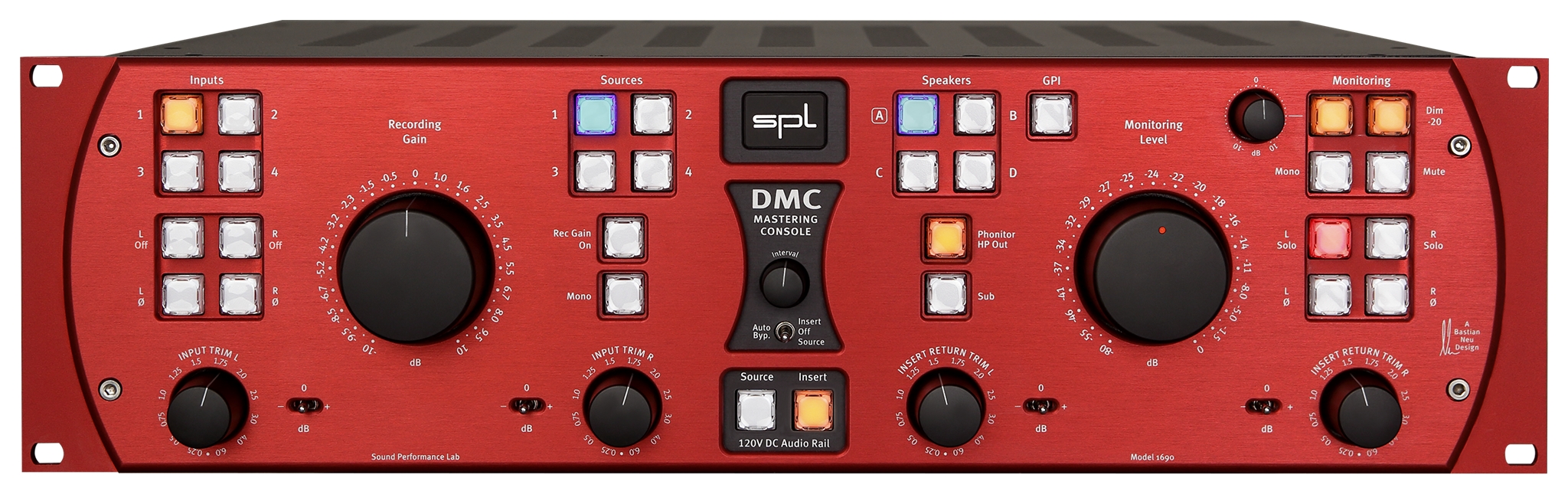
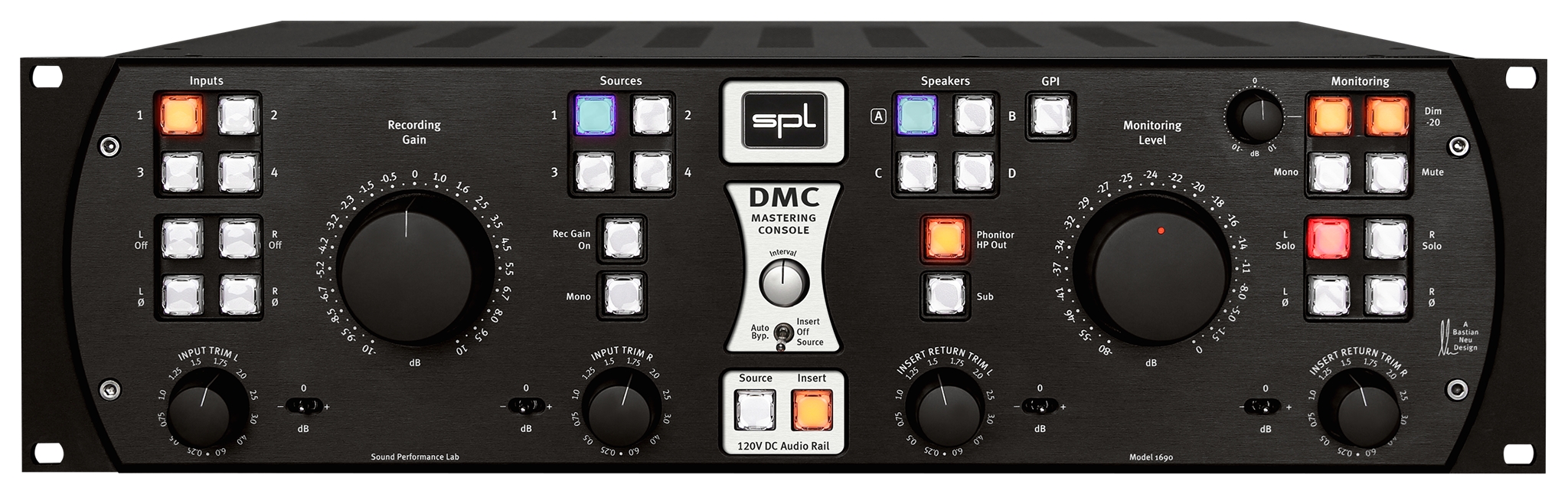
The new DMC Mastering Console has been redeveloped from the ground up. Not only is it much more flexible and has better technical specifications than all our previous mastering consoles - with its new ergonomic design, it also fits perfectly into all studio environments.It combines 4 stereo inputs, 4 stereo source inputs, 2 stereo recording outputs, 1 stereo insert as well as 3 stereo and 2 mono outputs in just 3 U.The DMC works with our 120 volt technology with our 5th generation SUPRA op-amps and can be combined with the MC16 (16 channel monitor controller).

€5,350.00
SPL Gemini
SPL Gemini
card.manufacturer:
Gemini is the first M/S mastering processor in 120V technology. Gemini introduces M/S processing to the SPL Mastering series. Gemini is an M/S encoder and decoder. Centre signals (voice, snare, bass ...) can be cleanly separated from spatial side signals (guitars, pads, cymbals ...) in a stereo mix and processed individually. When mastering the sum signal, M/S encoding is often the best way to gain targeted access to individual elements in a mix.Gemini also offers the option of editing the stereo panorama. The balance control can be used to shift the centre signal in the stereo panorama. The Trim control can be used to change the level of the centre signal in relation to the side signal. In conjunction with the Stereo Width control, the mixing ratio of both channels can be changed. An elliptical filter for cutting the low-frequency component of the sideband is also on board.

€2,460.00
SPL Madison
SPL Madison
card.manufacturer:
The Madison from SPL brings true SPL sound to any MADI-equipped audio router, PC or digital console. With 16 inputs and outputs in a single height unit, the Madison combines state-of-the-art audio signal conversion with the highest reliability in clock and MADI processing. Like every SPL device, it is of course easy to use, easy to expand - and of course a fantastic sounding converter system.

€1,999.00
SPL 2Control black
SPL 2Control black
card.manufacturer:
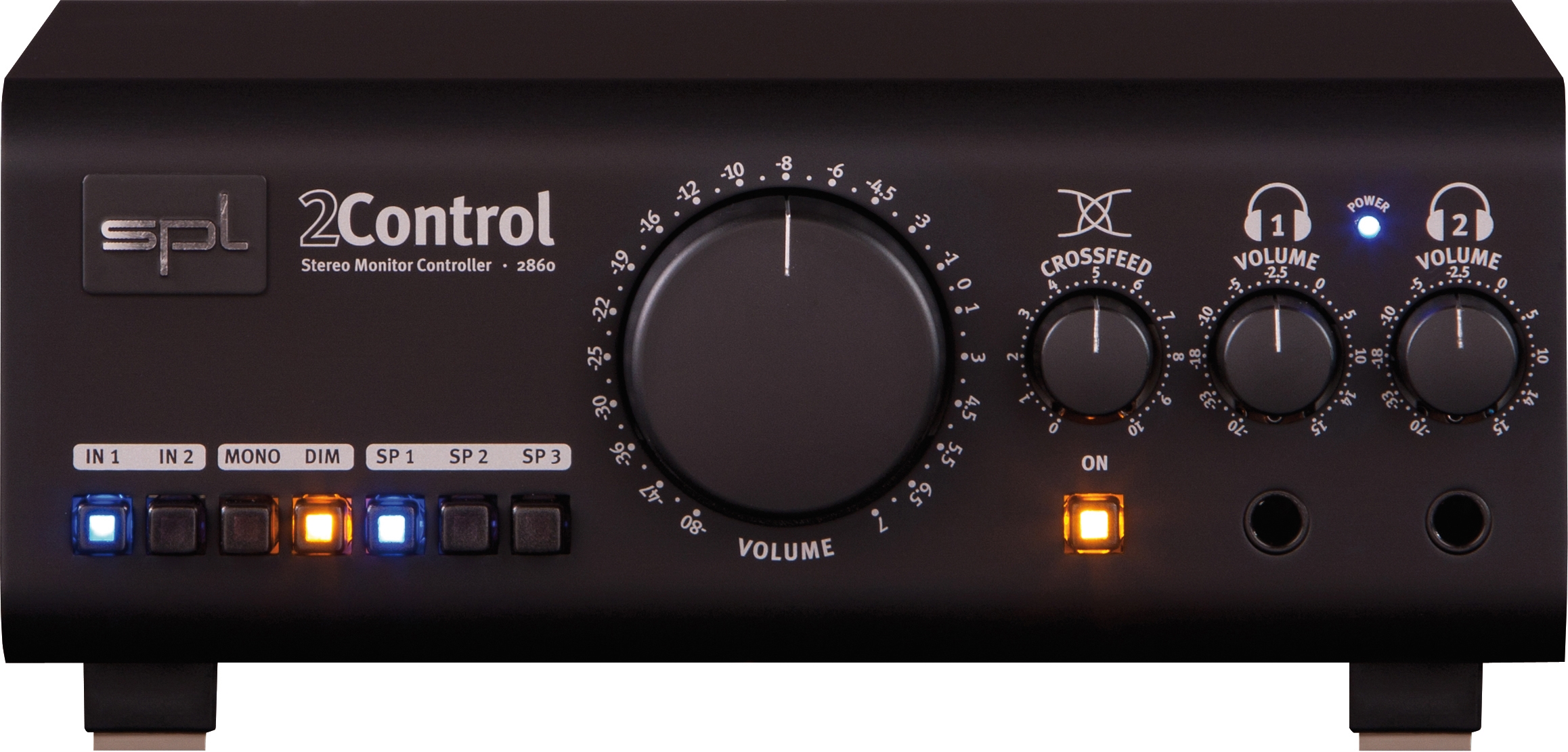
The 2Control with its innovative crossfeed stereo width control makes it possible for the first time to judge the stereo panorama of a mix on headphones in the same way as on loudspeakers. The concept has a consistent dual structure: Two channels, two sources, two sets of speakers, two sets of headphones - 2Control.The 2Control combines the two monitoring variants via loudspeakers and headphones in one compact, simple and high-quality controller: control the near-field and full-range monitoring as well as the headphone monitoring for two people with one central unit! Whether colleague or customer: someone always wants or needs to listen in. With the 2Control, this is centrally regulated - and done first class.The crosstalk of both channels can be adjusted to achieve an individually suitable stereo width. With the analogue crossfeed stereo width control, the range of application of the headphones is now considerably extended, as mixes can be assessed in the same way as with loudspeaker monitoring.Night-time home workers now have an alternative to full-range monitoring for assessing mixes in terms of room sound. Thanks to crossfeed control, headphone monitoring can not only be used as an analytical variant, but also as a fully-fledged secondary monitoring system. In addition, the 2Control - and thus familiar monitoring conditions - can be taken to other studios or production environments.SPL uses specially manufactured symmetry components for high common mode rejection and for operating long cable runs. Balanced connections reliably prevent interference or hum, so it is recommended to make balanced connections whenever possible.Unbalanced connections, for example from a CD player with cinch outputs or to a power amplifier with cinch inputs, can be made easily and without an adapter.Connect a mono speaker in addition to two stereo speaker sets. Or a subwoofer. Tip for working with headphones: Listen with a subwoofer so that you can physically feel the low bass.

€729.00
SPL DMC
SPL DMC
card.manufacturer:
The new DMC Mastering Console has been redeveloped from the ground up. Not only is it much more flexible and has better technical specifications than all our previous mastering consoles - with its new ergonomic design, it also fits perfectly into all studio environments.It combines 4 stereo inputs, 4 stereo source inputs, 2 stereo recording outputs, 1 stereo insert as well as 3 stereo and 2 mono outputs in just 3 U.The DMC works with our 120 volt technology with our 5th generation SUPRA op-amps and can be combined with the MC16 (16 channel monitor controller).

€5,350.00
SPL Channel One Mk III
card.manufacturer:

€2,199.00
SPL Control One
SPL Control One
card.manufacturer:
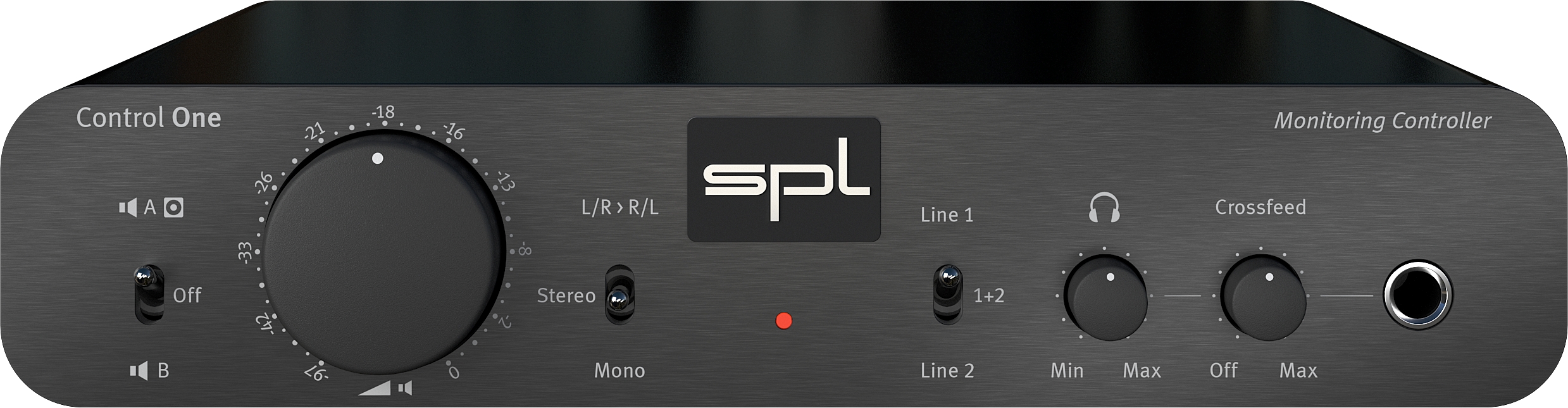
You can monitor your production via two switchable speaker pairs. A subwoofer is also switched on and off with speaker pair A.When the switch is in the centre position, the speakers are switched off, which is practical because you don't have to turn the volume control back.Two analogue stereo inputs can be connected to the Control One for players such as DA converters, CD players, mixing consoles, synthesizers or analogue tape machines/tape decks, which can also be mixed together (1+2).The selected input signal is output unchanged at the Line Out. This means that the Control One can be looped between devices without "losing" an output.If, for example, several people are to listen in via headphones, a headphone amplifier can simply be connected to the Line Out.You can also record the signal in analogue form or send it to a mixer for further processing.The Control One offers three monitoring modes. The default setting in the centre is "Stereo". To check the mono compatibility, set the switch to "Mono". The special feature is the channel swap function: L/R > R/Lreverses the stereo image. L/R becomes R/L. This is particularly important and extremely time-saving if you are looking for samples in the video dubbing that should match a scene with a direction of movement.If the direction is not correct, you normally have to load the sample into the DAW for channel swapping and swap the channels there before you can hear whether the sample fits.With the L/R > R/L function, this is no longer necessary. You can now swap the direction of movement in the sample library during pre-listening.The output stage of the headphone amplifier is designed as a push-pull amplifier in Class AB operation. The bipolar transistors share the amplification of the positive and negative half-wave, which produces a higher amplification and a higher output voltage than in Class A operation, in which only one transistor amplifies both half-waves.The output stage transistors are thermally coupled and therefore run particularly coherently, which contributes to a consistent and stable sound image.The power supply has a buffer circuit with low source resistance and thus ensures generous current reserves even when operating low-impedance headphones.The Phonitor Matrix has three setting parameters in the largest configuration: Crossfeed, Speaker Angle and Centre Level.In Control One, the centre level is preset to -1 dB and the speaker angle to 30°. These are the most commonly used values.The crossfeed function determines the crosstalk between the channels, the so-called interaural level difference. The intensity of the crossfeed is infinitely variable.At the beginning of the control path, the function is not in the audio path. It is only activated by adding it via a relay (hysteresis circuit). The audio signal therefore does not pass through the crossfeed stage if this is not desired.

€559.00
SPL Stereo Vitaliser MKIII-T
card.manufacturer:
The patented Vitalizer circuit makes the Vitalizer Mk3-T an unrivalled sound shaper. Audio productions sound livelier, have more detail, more transparency, a higher perceived loudness and, if required, an overwhelming bass foundation.The Vitalizer Mk3-T not only swaps the classic, golden garb of its predecessor for the new, black design of the SPL Studio series - the higher internal audio voltage of +/-18 V raises the third generation of this SPL classic to a higher sound level and shines with even better and more detailed sound.

€1,099.00