
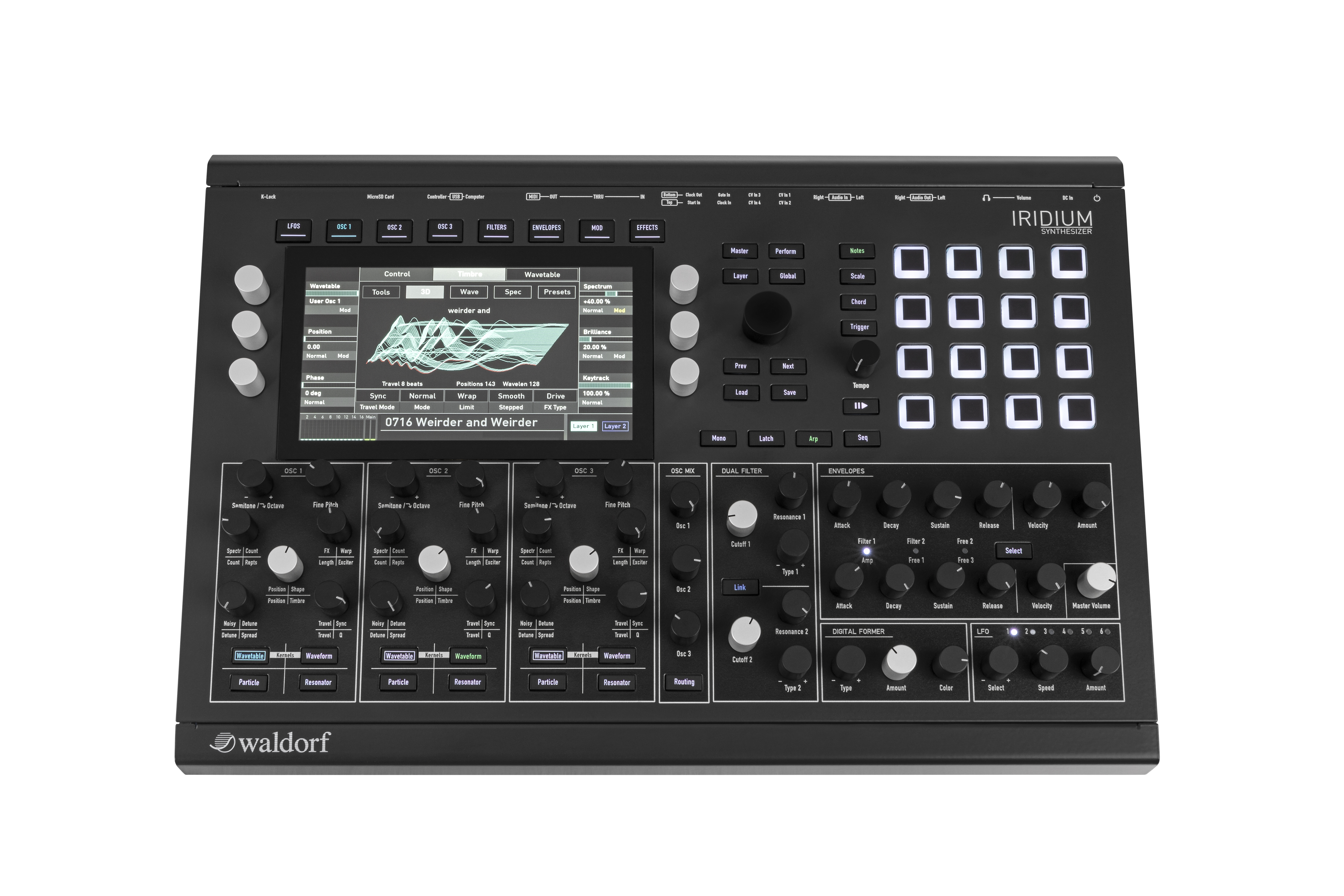


Waldorf Iridium
€1,969.00*
Prices incl. VAT plus shipping costs
(Free shipping from 49,-€ order value within Germany)

In stock
16-voice polyphonic, duo-timbral
Compatible with the synth engine of the Waldorf Quantum
3 oscillators
Wavetable
Waveform (VA)
Particle (sampling and granular sampling)
Resonator
Kernels (up to 6 sub-oscillators, which can be connected via FM at Audiorate)
3 stereo filters per voice
Dual Digital Filter
2 filters, independently adjustable
12/24dB LP/HP/BP in all combinations
Nave, Largo, PPG, Quantum and StateVariable as models
Filter models from Waldorf Nave, Largo and PPG in HP/LP/BP/Notch
Comb Filter
Bitcrusher
Drive
RingMod
StateVariable
Analyzer display in the filter view
Filter curve moves with modulation (optional)
Flexible routing options for filters with modulatable panning and levels
6 envelopes
6 LFOs
Complex modulator (freely characterisable shape for LFO or envelope)
Mod matrix with 40 slots, quick assignment, 1 additional control amount per slot, the same sources and destinations can be used as often as required (until the matrix is full), 4x4 silicone pad buttons with RGB lighting
Pads can play notes, chords, arpeggios and sequences
Latch mode
Arpeggiator
Step sequencer with up to 32 steps for notes and parameter lines
Favourites screen for quick patch recall
Modwheel, pitch bend and aftertouch can be operated via touchscreen Industrial-strength touchscreen, extremely smooth-running
Over 1000 factory sounds
Capacity for up to 7000 patches (slot numbers 0000-9999 can be used)
Patches from Quantum can be loaded into Iridium and vice versa
Category filter for patch list
2GB user sample memory
2x 6.3mm jack output (TS)
2x 6.3mm jack input (TS)
Headphones output with gain control
DIN MIDI In/Out/Thru
USB MIDI
USB host for memory and MIDI devices
MicroSD slot
Kensington® lock
4 CV inputs plus Gate In, Trigger In, Clock In, Clock Out
Inputs appear as sources in the mod matrix
Sturdy metal housing with aluminium knobs
Dimensions: 440mm x 305mm x 85mm
Weight: 5.4kg
Waldorf Iridium has made the impossible possible. The powerful synth engine of the Waldorf Quantum is now available in a handy format. Iridium follows in the footsteps of its big brother and offers all the synthesis elements of the Quantum in a rack-mountable housing. The combination of five synthesis models, incredible flexibility and sound design options down to the last detail open up new worlds of sound. The well thought-out operating concept, based on a logical layout and structured structure, allows you to create new sounds in no time at all. Packaged in a solid metal housing with high build quality, Iridium is ready to conquer recording studios and stages worldwide. As a descendant of the famous PPG Wave, Iridium joins the ranks of Waldorf Music's milestones. Iridium follows in the footsteps of the PPG, but offers much more than its predecessor.
Five different synthesis models are available for each of the three oscillators:
Wavetable
Waveform (virtual analogue)
Particle (sampling and granular sampling)
Resonator
Kernels
Kernel Mode was already released with OS 2.0 for Waldorf Quantum. This extensive upgrade makes it possible to transform an oscillator into up to six sub-oscillators. These can be linked together in any constellation via FM in Audiorate. The features added in this upgrade alone would have been enough to build your own synthesiser. All these functions are now also included in Iridium. Up to 7000 patches can be stored in Iridium. Quantum patches can be loaded into Iridium and vice versa.
Iridium offers three filters per voice. Two in the Dual Filter section and one in the Digital Former. Various filter types are available:
12 or 24dB and lowpass/highpass/bandpass with optional saturation or dirty mode.
The filter models from Waldorf Nave, Largo and PPG 3V are also available.
The two filters in the Dual Filter section can be controlled independently or in different link modes. The Digital Former contains all filter types and models from the Dual Dilter section plus some unusual filters such as Comb, Drive, Bitcrusher and more. All filters always work in stereo mode. Stereo channels are retained as such throughout the entire signal path. Six envelopes, six LFOs and many more modulation sources are just waiting to be used in the 40 slots of the Modulation Matrix. Each slot has an additional control amount. Almost any numerical value in Iridium can be used as a destination. All sources and destinations can be used as often as required until the matrix is full.
If the LFOs and envelopes are ever no longer sufficient, there is also the complex modulator. Another LFO or envelope can be created with a freely drawable line.
A large number of parameters are hidden beneath the surface of Iridium. Nevertheless, Waldorf has managed to pack everything into an operating concept that is easy to find your way around. The most important parameters have their own button, the rest can be accessed via the touchscreen and the encoders arranged around it. There are no deep menu structures here, but an operation that quickly leads to the goal and is really fun. There are 4x4 pad buttons on the front panel that invite you to play. These can be used to trigger notes, chords, arpeggios and sequences with up to 32 steps for notes and parameter progressions. The seven encoders to the left and right of the display provide direct access to the parameters on the touchscreen. Iridium's large touchscreen keeps you up to date and communicates with you. When you turn a knob, Iridium immediately shows the value change graphically on the display.
Filter curves move, particle grains change their size, envelope curves bend and much more:
Complex modulator curves can be drawn with your finger
Envelopes show where each voice is currently located
Wavetables are displayed graphically in different views
VU meters show the volume of each voice
Various analysers pick up the audio signal at different points and display it graphically. Two audio outputs send out the signal from Iridium, while two further connections record incoming signals and pass them on to the synthesis engine. Four CV inputs as well as Gate In and Trigger In enable the connection of Eurorack modules, which are then available as modulation sources in the matrix. Clock In and Clock Out also enable synchronisation to other devices. Iridium has connections for USB MIDI and DIN MIDIUsing the controller port, Iridium can use other MIDI devices as hosts and exchange data with sticks and hard drives via USB. Iridium also has a micro SD slot. Once again Waldorf has confirmed its status with musicians from all over the world with a new and exciting synthesiser. Iridium was conceived, designed and manufactured in Germany. All components used are of "industrial grade" quality and thus ensure a reliable synthesiser that will last a lifetime
Synthesiser that will continue to inspire musicians for many years to come.
Properties
| Polyphony: | 16 |
|---|---|
| Sound generation: | Digital |
Contact:
Waldorf Music GmbH
Lilienthalstr. 7
53424 Remagen
E-Mail: office@waldorfmusic.com
Web: https://waldorfmusic.com/
Waldorf Music is a German manufacturer of synthesizers and music production equipment founded in 1988. Known for its innovative and distinctive sounds, Waldorf has carved out a place for itself in the world of electronic music. The brand is particularly famous for its virtual analogue synthesizers, which impress with their unique timbres and creative possibilities. With products such as the MicroQ, Blofeld and Quantum, Waldorf has inspired both hobbyists and professional musicians. The company places great emphasis on quality and user-friendliness and always remains at the forefront of technological developments in the music industry.
Login