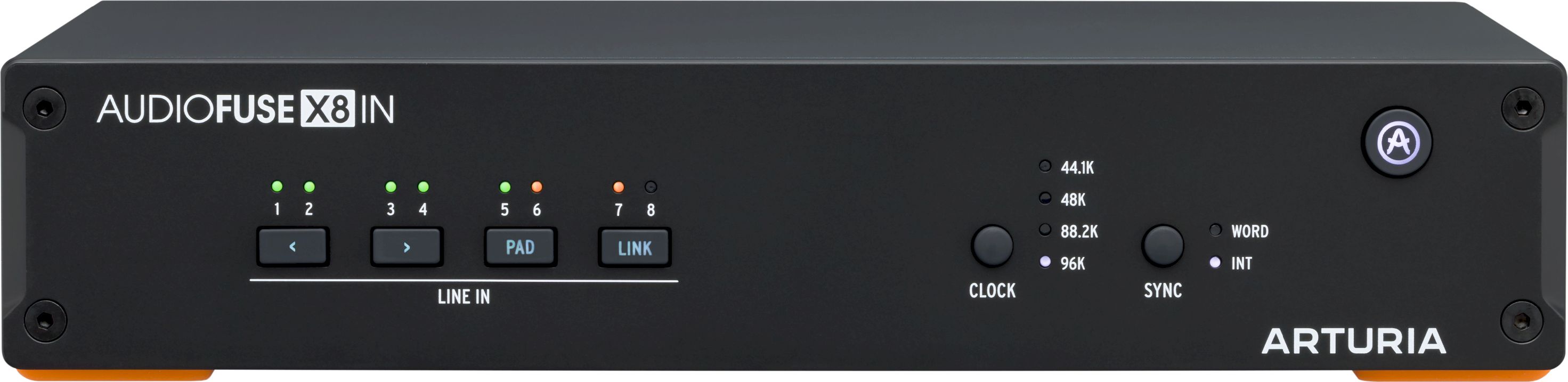
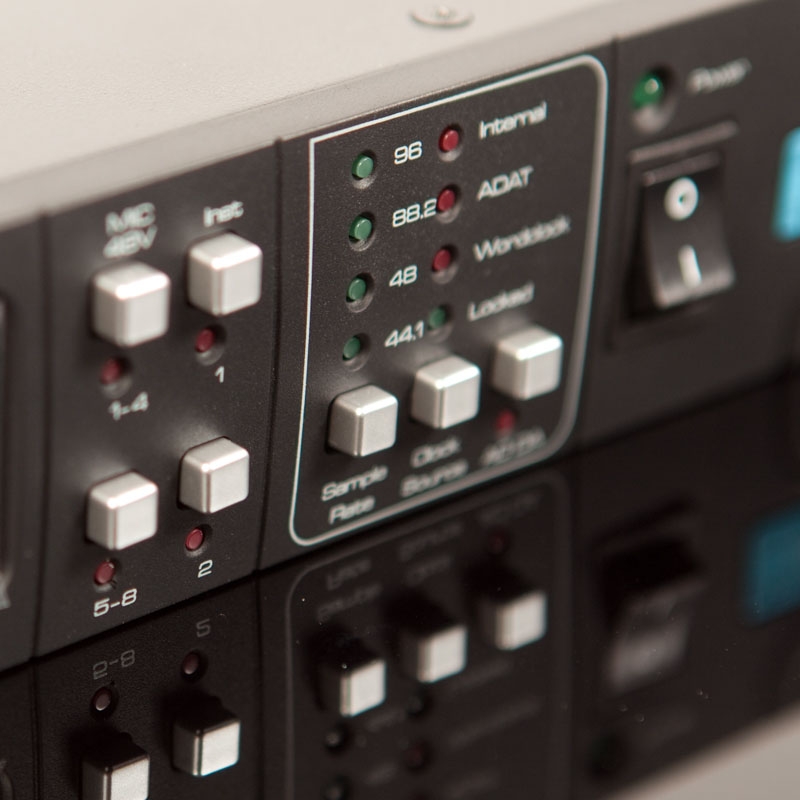
AudioFuse X8 IN is an ADAT expander that adds 8 high-quality line inputs to existing audio interfaces and expands the connection options of existing setups to the highest studio quality.The AudioFuse X8 IN is an indispensable tool for producers, sound engineers and live musicians who are looking for additional high-quality analogue inputs. By expanding analogue-digital connectivity, the AudioFuse X8 IN offers more channels for instruments and external equipment. It increases the flexibility and scalability of your studio without sacrificing audio quality and fulfils the highest sonic demands.In particular, an 8-channel analogue-to-ADAT input expander allows you to expand your synth and instrument setup so that all your equipment is connected and ready to record in your DAW at the same time.Efficient expansion:The AudioFuse X8 IN provides 8 additional analogue line inputs and improves the connectivity of your existing audio setup without the unnecessary cost and hassle of another full-featured audio interface.Professional audio quality:The AudioFuse X8 IN supports 8 channels of premium analogue-to-ADAT conversion at up to 96 kHz and uses the best components available to ensure your recordings maintain the highest fidelity.Flexible use:The AudioFuse X8 IN is designed as a half rack unit and allows flexible use both as a desktop device and for mounting two AudioFuse X8 units in a 19-rack.Simple operation:Front panel controls provide direct access to channel management, making setup and adjustments straightforward. Coloured LEDs also provide visual feedback for level monitoring.
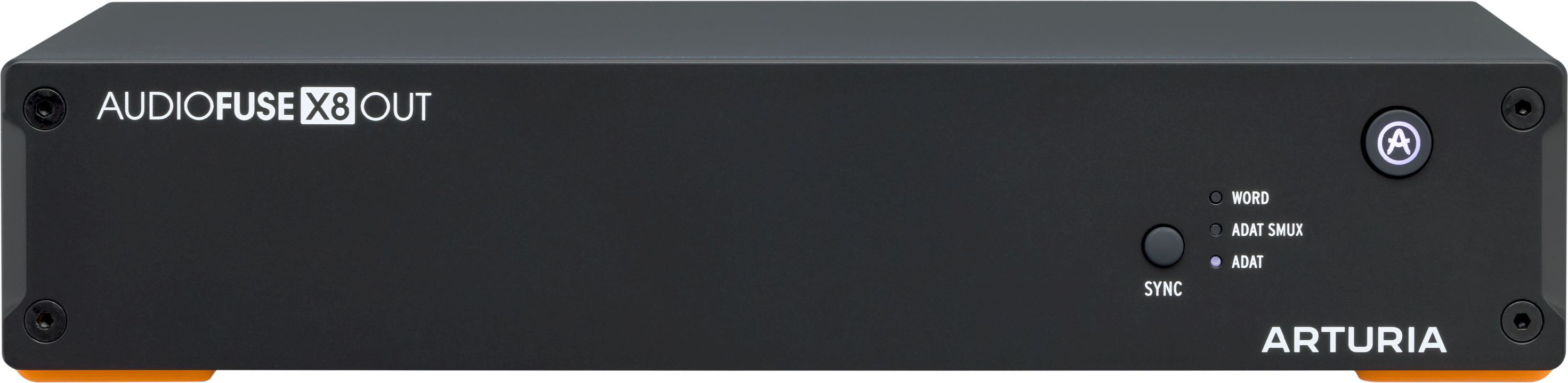
AudioFuse X8 OUT is an ADAT expander that adds 8 high-quality line outputs to existing audio interfaces and expands the connection options of existing setups to the highest studio quality.The AudioFuse X8 OUT is an indispensable tool for producers, sound engineers and live musicians who are looking for additional high-quality analogue outputs. By expanding digital-analogue connectivity, the AudioFuse X8 OUT provides more channels to support complex signal paths for live setups or external audio workflows in the studio. It increases the flexibility and scalability of your studio without sacrificing audio quality and fulfils the highest sonic demands.Specifically, an 8-channel ADAT-to-analogue output expander allows you to send audio signals to external equipment (hardware effects, modular systems, mixing consoles, etc.), add additional speakers and control a variety of synthesizers via DC-coupled outputs.Efficient expansion:The AudioFuse X8 OUT provides 8 additional line outputs via ADAT, expanding the connectivity of your existing audio setup without the unnecessary cost and hassle of another full-featured audio interface.Professional audio quality:The AudioFuse X8 OUT supports 8 channels of ADAT to analogue conversion at the highest quality up to 96 kHz and uses the best components on the market to ensure that your recordings and outputs maintain the highest fidelity.Flexible use:The AudioFuse X8 Out is designed as a half-rack unit and allows flexible use both as a desktop unit and for mounting two AudioFuse X8 units in a 19-rack.Robust construction:The AudioFuse X8 OUT was developed for tough studio and live use and has simple controls on the front, a robust mains connection and stable jack outputs.
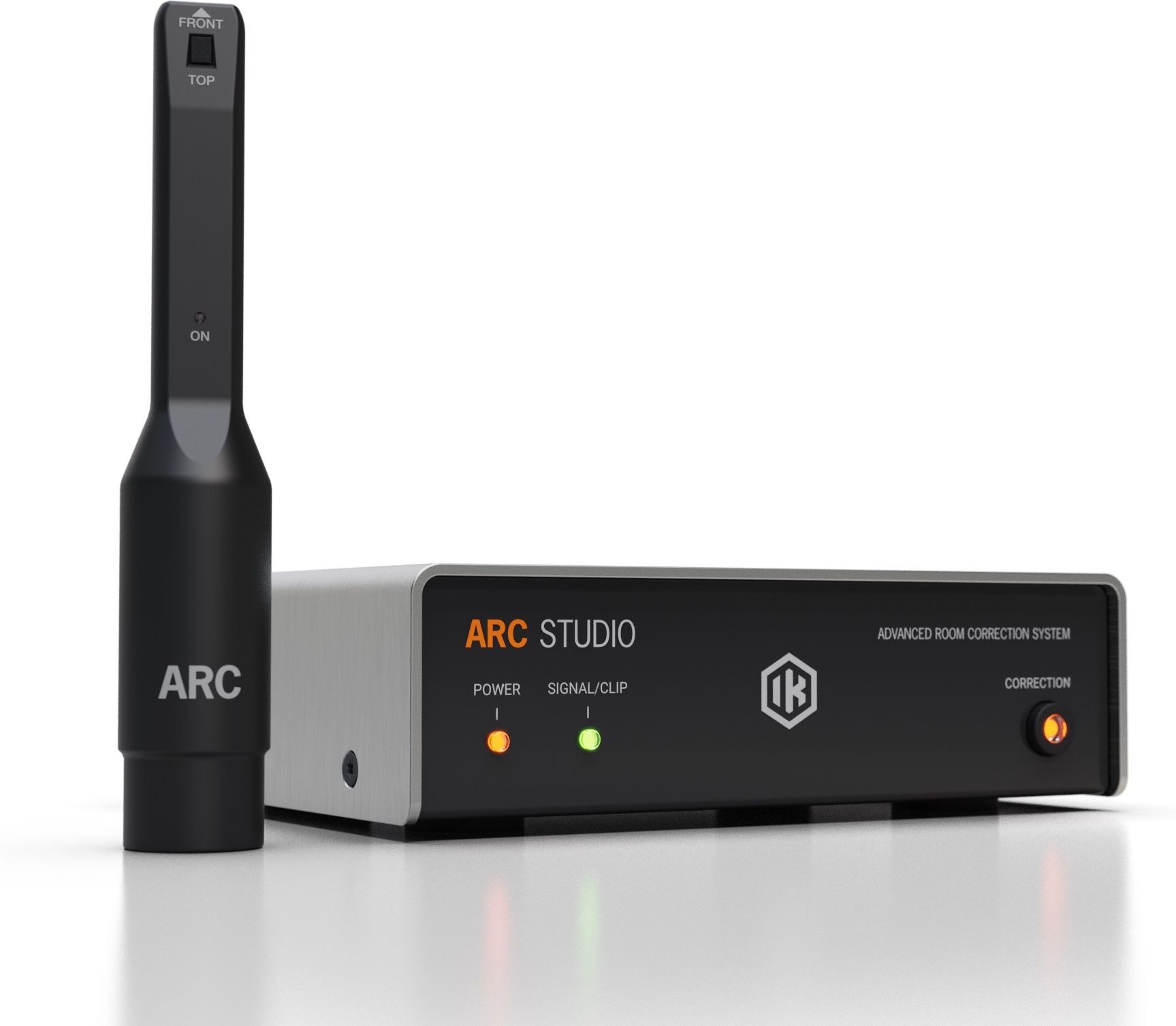
ARC Studio is a standalone room correction solution for stereo monitoring systems, It combines a hardware processor, the ARC 4 software and a precise MEMS Measurement microphone. The completely new algorithm corrects unfavourable acoustic conditions that could otherwise lead to an incorrect mix.The system thus enables a natural and transparent sound that guarantees reproducible results.The quality of the monitoring path is crucial. ARC Studio offers a dynamic range of 120 dB(A) between analogue input and output, a frequency response of 0.5Hz to 40kHz and ultra-stable clocking for infinitesimally low jitter. This ensures sonic transparency and accuracy that can only be found in professional audio interfaces and mastering-grade audio converters Mastering-grade audio converters.The connection to studio monitors is made via balanced XLR connectors, which are equipped with relay-based hard bypass to prevent unwanted background noise.
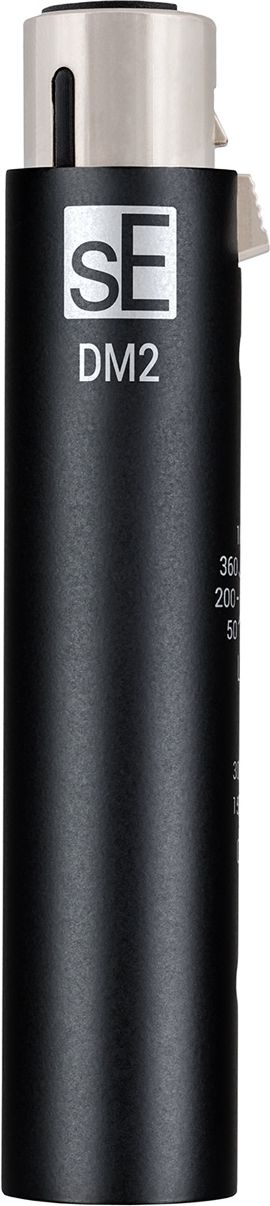
The DM2 T.N.T is an active inline preamplifier based on the design of the sE DM1, but offering even more gain and less noise with greater flexibility. The integrated, recessed switch allows you to select a clean, transparent gain of a moderate 15 dB or an explosive 30 dB - more headroom and an extremely clean signal, with an ultra-high impedance input and eight selectable load settings to perfectly match any microphone. It is suitable for direct connection to the output of a passive ribbon or dynamic microphone, eliminating the need for an additional cable.Switchable, clean gain from a moderate 15 dB to an explosive 30 dB:Two amplifier stages provide even greater flexibility with different microphones, designed for neutral, balanced sound quality and extremely low noise. The uncompromising design amplifies the signal regardless of load impedance or cable length. The DM2 T.N.T can be perfectly combined with any passive microphone, boosts the signal, reduces the occurrence of interference and provides a significantly better level for the preamplifier of the audio interface / mixer - all without noise and colouration!Get the best out of the microphone thanks to the variable input load:Conventional inline preamps tend to load the transducers of passive microphones due to their electronic design, resulting in a degradation of sound quality and output level. The ultra-high impedance input of the DM2 T.N.T promises the best possible signal quality, regardless of the load of the microphone. The selectable impedance of the DM2 invites experimentation - it can be adjusted from an unconventionally low 50 to an astonishingly high 10 M to match the preamp to any microphone and achieve a clean recording with the lowest possible noise. The DM2 T.N.T was developed to bring out the best sound characteristics of each microphone.Sophisticated Class A electronics with additional output stage:With a sophisticated electronic design and specially selected high-quality FET transistors, the DM2 T.N.T has the lowest self-noise in its class and enables effortless studio-quality recordings. Unlike other commercially available inline preamplifiers, the DM2 T.N.T delivers a constant gain of +15 dB / +30 dB regardless of the connected load. An ideal tool for sound engineers, the DM2 T.N.T's output impedance is also the lowest in its class, making it easy to handle long cable runs while reducing susceptibility to RF interference, hum and noise.Slim, robust all-metal housing with premium finish:Even in the most demanding environments, the DM2 T.N.T scores with a stage-ready and sleek all-metal design, robust construction, high-quality manufacturing standards and a gold-plated XLR connector for reliable lossless signal connection, whether on stage or in the studio. With its exceptionally practical, phantom-powered design that requires no external power supply, the sE DM2 T.N.T is the ultimate game changer in your pro audio arsenal.
The Warm Audio WA76 is a new edition of the legendary FET compressor with an unrivalled price/performance ratio. With its authentic look, discrete Class A circuitry and typical sound, this version of Bill Putnam's limiter is a must-have for every recording studio.
Expand your studio with the Black Lion Revolution EXP. The high-quality AD/DA converter delivers 16 analogue TRS jacks (8-in, 8-out) and 16 channels of ADAT I/O. The precise Macro MMC clocking technology ensures exceptional clarity up to 192 kHz. For high-quality Black Lion Audio sound, the robust metal housing contains boutique components from Nichicon, Vishay and Wima. The eight-stage display of the inputs and outputs enables simple and precise level checking.
Bento 2 is a 19 inch, 1U rackmount rack for two 500 series modules. It is equipped with an internal power supply (90Vac - 240Vac, 50Hz-60Hz) +/- 16V (+/- 900mA) and +48V (35mA). The device is equipped with balanced jack and XLR inputs/outputs and can be switched on/off at the front and rear, which is very useful for rack installation. the audio routing and the link function can be switched on the rear panel. The multi-layer rear panel guarantees minimum noise and maximum signal integrity.
The Aurora defined the standards in transparency, reliability and value stability for professional A/D D/A converters and is at the centre of professional recording studios around the world. The completely redesigned Aurora(n) continues this legacy. The new member of the Lynx family builds on the features that made the Aurora famous. The innovative design means that the Aurora(n) sounds better, is more flexible, fits better into new applications and is therefore even more suitable as the centrepiece of your recording studio. The Aurora(n) delivers the detailed recording and playback you expect today, while being expandable and ready for whatever the future holds for your studio. We've designed Aurora(n) to be the last audio converter you'll buy! Simply because we've listened to you and built a precision audio tool that's exactly what you want.
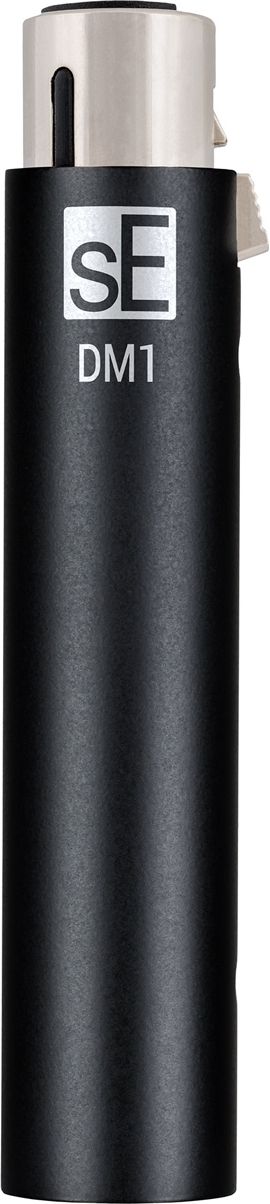
The DM1 DYNAMITE is an active inline preamplifier that is connected between a passive ribbon or dynamic microphone and a microphone preamplifier. The DM1 offers a gain of +28dB, making it the perfect solution for amplifying the signal of a passive microphone, reducing the occurrence of interference and significantly increasing the preamplification - without adding noise or colouration With a sophisticated Class A design and specially selected high-quality FET transistors, the DM1 has the lowest self-noise in its class. In addition, the dedicated output isolation amplifier offers a constant gain of 28 dB, regardless of the connected load. Its output impedance is also the lowest in its class, allowing it to run long cable runs while reducing susceptibility to RF interference, hum and noise.The roadworthy and slim all-metal design, robust construction and high manufacturing standards ensure reliable operation even in demanding applications on stage in difficult environments.
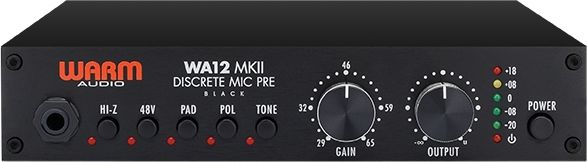
If the mix sounds as clinically pure and flat as the wallpaper on the wall, it's time for the Warm Audio WA12 MKII. Here we are back in a time when signals were still alive and had character. Plain vocals and instruments are given that certain "something", become deeply layered and exciting.Thanks to the built-in X731 OpAmp, the WA12 MKII can sound lively, clean and lifelike, but can also go into mild saturation at higher amplification levels. The resulting harmonic distortion is an enrichment for any mix.The often neglected power supply for the preamplifier is provided by a sophisticated internal power supply unit with a low-noise toroidal transformer.
The nvelope 500 is a powerful audio processor capable of making subtle or drastic changes to the signal by allowing control over the attack and sustain characteristics. This is extremely useful for shaping all kinds of individual signals and is an excellent tool in any mixing situation. Drums and other percussive signals in particular will benefit from the magic of the nvelope.The nvelope 500 can effectively change the spatial perception of a signal, from small/dry to big/wet. You can use it to shape a signal and improve its contribution to the mix without deforming it too much, as you would with excessive EQ and compression.
The Aurora defined the standards in transparency, reliability and value stability for professional A/D D/A converters and is at the centre of professional recording studios around the world. The completely redesigned Aurora(n) continues this legacy. The new member of the Lynx family builds on the features that made the Aurora famous. The innovative design means that the Aurora(n) sounds better, is more flexible, fits better into new applications and is therefore even more suitable as the centrepiece of your recording studio. The Aurora(n) delivers the detailed recording and playback you expect today, while being expandable and ready for whatever the future holds for your studio. We've designed Aurora(n) to be the last audio converter you'll buy! Simply because we've listened to you and built a precision audio tool that's exactly what you want.
The Dante AVIO Bluetooth adapter provides wireless connections to Dante networks for mobile devices and computers.It is suitable for playback from smartphones to larger sound systems as well as for connecting networked speakers and microphones to conferencing software.Once configured, a user can rely on Bluetooth to switch from local smartphone audio to a full conferencing system to share voice with others.
Der Hilo Referenz A/D D/A Wandler von Lynx Studio Technology definiert das Konzept und die Funktionalität von Zweikanal-Wandlern vollständig neu. Hilo ist drei Geräte in einem: A/D Wandler, D/A Wandler, Kopfhörerverstärker. Hilo vereinigt hierbei mit seinen insgesamt 12 Eingängen und 16 Ausgängen Anschlußvielfalt, Leistung und Kontrollmöglichkeiten in bisher noch nicht gesehener Form.Hilo bietet zweikanalige A/D Wandlung in Masteringqualität, bis zu 6 Kanäle D/A Wandlung, einen Line Eingang und einen Line Ausgang mit jeweils 8 Trimeinstellungen, einen zweiten unabhängigen Monitor Ausgang sowie einen ebenfalls unabhängigen, qualitativ extrem hochwertigen Kopfhörerverstärker in einem attraktiven kompakten Gehäuse halber Rackbreite. Erstmalig bei einem Zweikanal-Wandler besitzt Hilo einen innovativen 10 x 7,5 Zentimeter großen und mit 480 x 272 Pixeln aufgelösten, berührungsempfindlichen Farbbildschirm, über den die komplette Bedienung aller Funktionen des Wandlers vorgenommen werden kann.
The Rupert Neve Designs Portico 517 quickly becomes indispensable for both live and studio applications thanks to its versatility. It offers both a transformer-balanced microphone input and an instrument input, the phase of which can be continuously adjusted using the Vari-Phase control. As both signals can be mixed together in the device, the optimum phase position can be set in relation to each other. A musical compressor with variable threshold compresses the audio signal if required. The selectable Silk circuit provides the coveted vintage warmth in the audio signal.The microphone preamp:The Portico 517's preamplifier combines outstanding sonic quality with the musicality you would expect from a Rupert Neve design. Thanks to the extremely low distortion, the extraordinarily wide bandwidth and the switchable Silk function, the preamp captures every last detail of the microphone signal.The compressor:Based on a new LDR (Light Dependend Resister) design, the 517's opto-compressor has been reduced to the essentials and offers threshold control with automatic catch-up gain. The compressor is set to a fixed compression ratio of 2:1 ex works. To operate it, simply change the threshold until the desired compression is achieved. An LED indicates the activity of the compressor.Crossfading:In instrument applications, the Portico 517 is used for phase adjustment as well as crossfading and compression of direct (DI) and amplified, miked signals (Mic); the adjustable crossfade between direct and amplified signals allows you to quickly set the desired tonal mix between the two sources; phase cancellations can be minimised using phase control. To compress the mixed signal, the jumper for the compressor must be set to the "Blend" path (factory setting). Of course, it is also possible to create a mixed vocals/guitar signal in this way.Vari-Phase:In addition to the normal phase inversion, the Portico 517 offers a Vari-Phase module for infinitely variable control of the phase position between the two inputs. This is important for all signals coming from the same source.Even with careful mounting of drums (close miking) and overheads, phase problems can make the overall signal sound muffled or muddy. Vari-Phase can be used to rotate the phase of the direct signal until the signals are in phase.This technique is also very useful in combination with the internal crossfade when recording instruments. A bassist who feeds the Portico with both direct and microphone signals can mix both signals into a sum signal, whereby he can use Vari-Phase to bring them into optimum phase alignment.
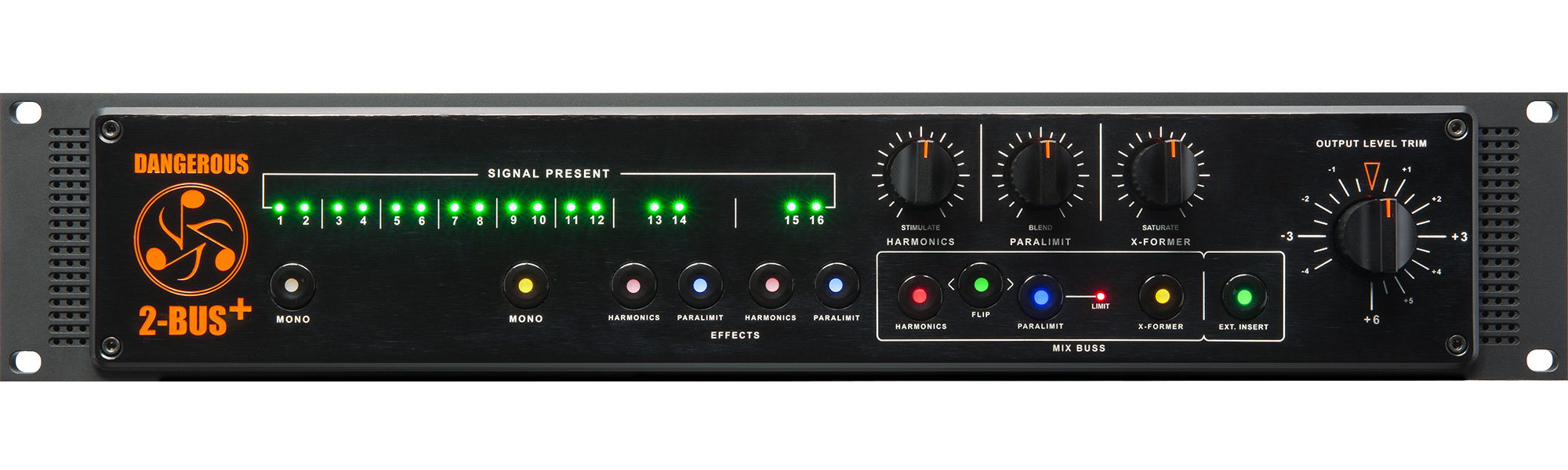
To add colour and character to your mixes, the design team at Dangerous have created three completely unique fully analogue circuits: Harmonics, Paralimit and X-Former. Because these circuits are hardwired into the 2-BUS+ (pronounced "Tuh Bass Plass"), you get a versatile selection of analogue colouration without having to leave the lush yet open mixing environment.Harmonics - Add the euphoric sound of an analogue circuit on the edge of distortion to the entire mix, or just a single channel pair. Care has been taken to find the perfect balance of even and odd harmonics. This effect is applied in parallel with the unprocessed signal. The "STIMULATE" control allows you to adjust exactly how much of it you want. The treble shimmers subtly, the bass growls pleasantly and the whole sound is warmed up a little in a way that only a genuine analogue circuit can do.Paralimit - A FET limiter set to the right. An original Chris Muth design inspired by the famous 1176 Limiting Amplifier on "All Buttons in": a ratio to infinity and analogue sparkle in the highs. With its "BLEND" control and assignment switches, the Paralimit enables parallel compression in the simplest and most direct way, in stereo, at analogue level, on the whole mix or just on one stereo channel pair - a flexible setup that would otherwise require complex cabling, meticulous level balancing and a not inconsiderable amount of outboard gear.X-former - Last in the path is a pair of custom Cinemag transformers, characterised by Chris Muth's utterly unique approach to driving the transformer into saturation. Switch it on to get the solid, punchy sound that makes old consoles so popular - and then turn in the "SATURATE" knob to drive the transformer more and more into saturation in a way that only the 2-BUS+ can. The X-former is all about having just the right amount of colouration of a classic analogue console available when you need it.
The MEC 1A Recording Channel combines three Tube-Tech devices in one: the MP 1A microphone preamplifier, the EQ 1A equaliser and the CL 1B compressor. This combination offers the greatest possible flexibility in sound processing, allowing both subtle and progressive interventions. The MEC 1A is more than just a channel strip - it is a creative tool.
The AEA RPQ2 preamplifier and EQ offers two channels of high output power, high impedance and low noise with a rich and natural sound that brings out the full potential of your microphones.
The Warm Audio WA76 is a new edition of the legendary FET compressor with an unrivalled price/performance ratio. With its authentic look, discrete Class A circuitry and typical sound, this version of Bill Putnam's limiter is a must-have for every recording studio.
The Hilo reference A/D D/A converter from Lynx Studio Technology completely redefines the concept and functionality of two-channel converters. Hilo is three devices in one: A/D converter, D/A converter, headphone amplifier. With a total of 12 inputs and 16 outputs, Hilo combines connectivity, performance and control in a way never seen before. Hilo offers two-channel A/D conversion in mastering quality, up to 6 channels of D/A conversion, a line input and a line output with 8 trim settings each, a second independent monitor output as well as an independent, extremely high quality headphone amplifier in an attractive, compact half-rack width housing. For the first time in a two-channel converter, Hilo has an innovative 10 x 7.5 centimetre touch-sensitive colour screen with a resolution of 480 x 272 pixels, which can be used to operate all of the converter's functions. All controls and signal routing are accessible via easy-to-use menus. The main page shows two stereo input bar graphs and three stereo output bar graphs. Optional displays offer two further selectable displays and even VU pointer instruments. Additional metering options, diagnostic modes and personalisation will be made available in the future via downloadable FPGA updates.
The first generation Passeq was the first passive equaliser to provide three separate frequency ranges for boost and cut. With 12 switchable frequencies per band, i.e. 36 frequencies for the cut and 36 frequencies for the boost, the Passeq was the most powerful passive EQ filter network of all time. The same number of boost and cut frequencies is now also available in the new PASSEQ Mastering Equaliser. However, the selection of frequencies has been changed and the Q factor, or quality factor, has been individually re-tuned for each selectable frequency using an optimised coil, capacitor and resistor combination. Each boost and cut frequency now has an individually optimised Q factor.The entire passive filter (variable resistor, capacitor and coil) delivers a very nice sound characteristic. In addition to the choice of components, the charging behaviour of the capacitors and the saturation behaviour of the coils play a major role in this. The resulting relative inertia compared to potentially very fast active filters is the reason for a pleasant, musically favourable sound characteristic. We would choose smoothness and transparency as well as strikingly silky highs and pithy basses as a suitable description for our perception.During fine-tuning, through component selection, in countless listening sessions, the focus was on achieving the most musical sounding curves possible, which need not shy away from comparison with a Pultec EQ from the 1950/60s, for example. But without all the disadvantages of a 60-year-old original, such as the very high noise floor, but above all the very limited frequency selection.The mid-range bands in particular are now more harmonically tuned for sum processing than on the previous model. The mid range cut band now starts working from 200Hz. We have had new coils specially made for this purpose.Another highlight of the new PASSEQ is therefore the HF+ band, which has been extended by the frequencies 25kHz and 35kHz and sounds so incredibly good that you won't want to switch it off.The output level can now be raised or lowered by 10dB using the large rasterised output control in order to address subsequent devices at the perfect working level. This is particularly important for use in mastering.The gain, Q (HF +) and output parameters of the PASSEQ mastering equaliser can be set in 41 steps using rasterised potentiometers (ALPS RK27 "big blue"). All other parameters are switched via 12-position switches. A perfect recall of all settings is therefore easy to realise thanks to these switches and the detented potentiometers,As with all new SPL mastering devices, the new PASSEQ also features auto baypass. Each of the two channels can of course be deactivated or activated manually using the large illuminated buttons. However, thanks to the auto bypass, this can also be done automatically in a freely selectable time window.
Many successful recordings of the 80s bear the signature of SSL 4000 E mixing consoles. This is not least due to the versatile dynamics section of the legendary 611E channel strip, which is appreciated by producers all over the world. This tool has been used to optimise numerous honourable kick drum punches and bass thrusts as well as to tame prominent but "very dynamic" vocal parts.
The Hilo reference A/D D/A converter from Lynx Studio Technologycompletely redefinesthe concept and functionalityof two-channel converters. Hilo is three devices in one: A/D converter, D/A converter, headphone amplifier. With a total of 12 inputs and 16 outputs, Hilo combines connectivity, performance and control in a way never seen before. Hilo offers two-channel A/D conversion in mastering quality, up to 6 channels of D/A conversion, a line input and a line output with 8 trim settings each, a second independent monitor output as well as an independent, extremely high quality headphone amplifier in an attractive, compact half-rack width housing. For the first time in a two-channel converter, Hilo has an innovative 10 x 7.5 centimetre touch-sensitive colour screen with a resolution of 480 x 272 pixels, which can be used to operate all of the converter's functions. All controls and signal routing are accessible via easy-to-use menus. The main page shows two stereo input bar graphs and three stereo output bar graphs. Optional displays offer two further selectable displays and even VU pointer instruments. Additional metering options, diagnostic modes and personalisation will be made available in the future via downloadable FPGA updates. The digital connection section offers a wide range of inputs and outputs. The AES/EBU inputs and outputs have transformer-coupled, balanced XLR connectors. The S/PDIF inputs and outputs are available as either transformer-coupled coaxial or optical TOSLINK connections. The optical ports can also be used for 8-channel ADAT operation. The ADAT input and output channels are completely independent of the AES/EBU or coaxial S/PDIF channels. Also included are the Lynx Low Jitter SynchroLock word clock technology, as well as one word clock input and output each.
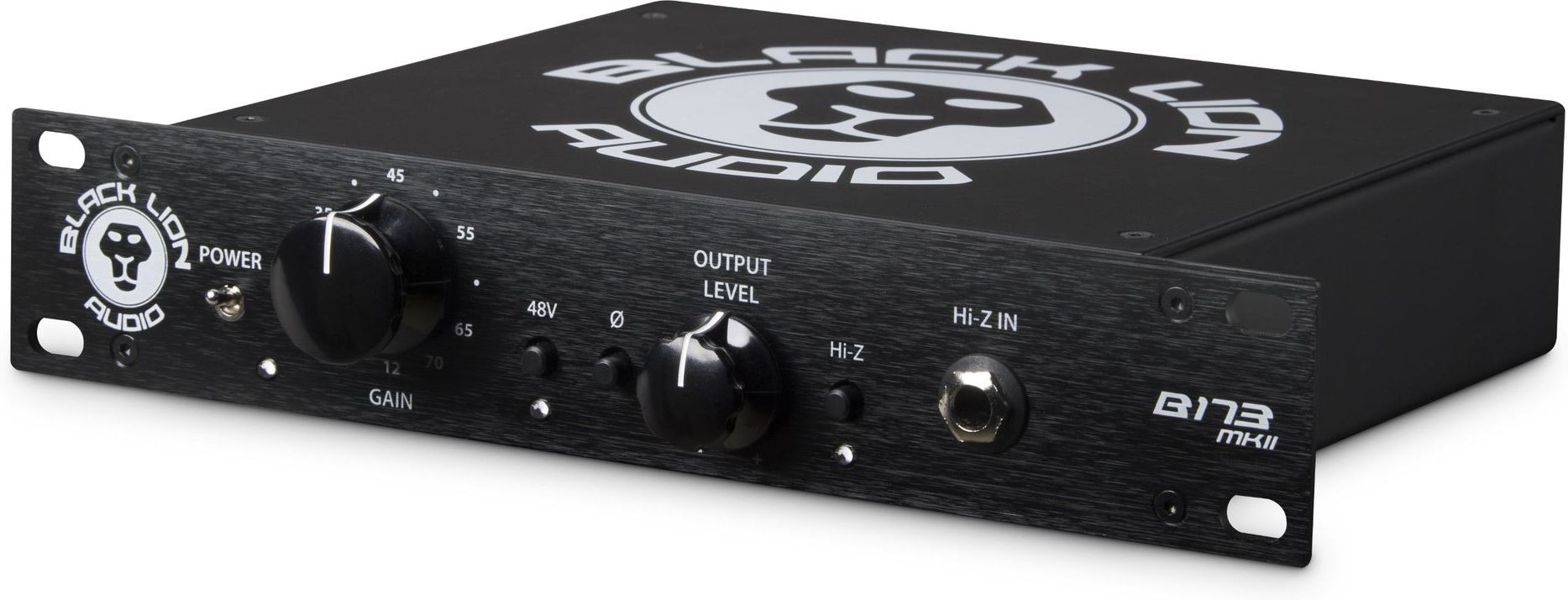
Don't be fooled by the price. The B173 preamp combines high-quality workmanship with the best price/performance ratio. The B173 is Black Lion Audio's homage to the revered Neve 1073 microphone preamp. The aim of product development was to recreate the essence of the Neve 1073 as faithfully as possible.
We have looked at many converter designs and asked ourselves why innovations take place almost exclusively on the digital level and only very rarely on the analogue side. Perhaps it is because most developers have their background in digital technology and therefore tend to develop analogue technology according to the 'cookbook'.We have 30 years of experience in analogue technology and we find cookbook designs rather boring, inefficient and in need of improvement.The output of the DAC IC (AK4490) is an analogue signal that needs to be filtered with a low-pass filter. This analogue circuit is typically operated with the same voltage as the DAC IC - for example 5V. Imagine that the first stage that finds the analogue signal has a dynamic range and signal-to-noise ratio limited by this voltage. What a bottleneck.In the Mercury, our 120V technology is used instead of the standard technology. And it does so twice in the newly developed DLP120 module. DLP stands for "Dual Low Pass". These are two separate analogue filters using 120V technology. Depending on the type of digital signal, the analogue signal passes through the PCM or DSD filter and can freely unfold into a huge dynamic range. This is audibly better.The DA converter (DAC) in the Mercury is the AK4490 Velvet Sound® converter chip from AKM. This offers a bit depth of 32 bits and a maximum sampling rate of 768 kHz for PCM digital signals and DSD4 or DSD256 for direct stream digital signals.